Showing posts with label corporations. Show all posts

Sunday, 7 December 2025

Landmark glyphosate safety study retracted for Monsanto ghostwriting, other ethics problems

 A scientific study that regulators around the world relied on for decades to justify continued approval of glyphosate was quietly retracted last Friday over serious ethical issues including secret authorship by Monsanto employees – raising questions about the pesticide-approval process in the U.S. and globally.  

The April 2000 study by Gary Williams, Robert Kroes and Ian Munro – which concluded glyphosate does not pose a health risk to humans at typical exposure levels – was ghostwritten by Monsanto employees, and was “based solely on unpublished studies from Monsanto,” wrote Martin van den Berg, co-editor-in-chief of Regulatory Toxicology and Pharmacology. It also ignored “multiple other long-term chronic toxicity and carcinogenicity studies” that were available at the time.

Some of the study authors may also have received undisclosed financial compensation from Monsanto, he noted. Because of these problems, the editors “lost confidence in the results and conclusions of the article,” van den Berg wrote. 

The retraction came years after internal corporate documents first revealed in 2017 that Monsanto employees were heavily involved in drafting the paper.

“What took them so long to retract it?” asked Michael Hansen, senior scientist of advocacy at Consumer Reports. “The retraction should have happened right after the documents came out.” 

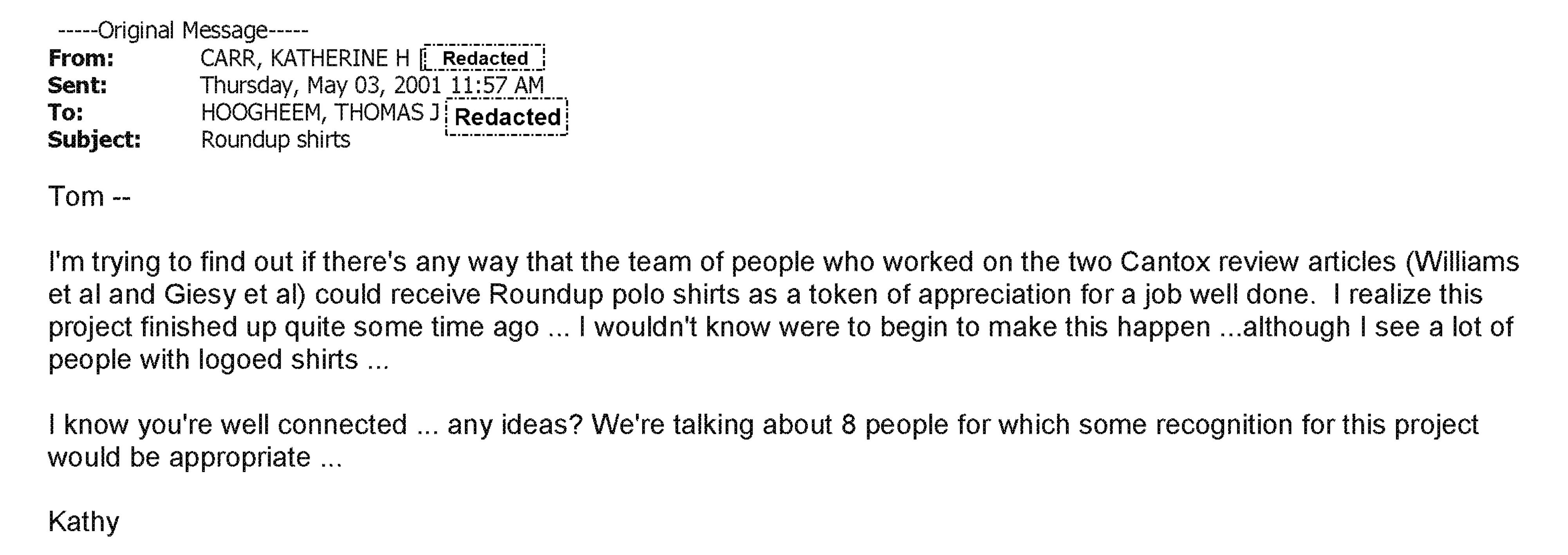
In one email from 2001, Monsanto scientist Katherine Carr asked if the “team of people” at Monsanto who worked on the Williams paper “could receive Roundup polo shirts as a token of appreciation for a job well done.”
Flawed paper was foundational for regulatory approval

While Monsanto scientists congratulated each other, glyphosate use was surging around the world; it is the most used herbicide in history. And the Williams paper played a key role in its continued acceptance as safe to use. 

“Government documents from public health agencies around the world … cite this ghostwritten paper without caveat even after the 2017 revelations, affecting policy and shaping public perception of glyphosate’s safety,” wrote researcher Alexander Kaurov and Harvard historian Naomi Oreskes in an August article in Undark.

The ghostwritten paper “exerted considerable influence over two decades, shaping public understanding, scientific discourse and policy decisions,” Kaurov and Oreskes wrote in a September 2025 paper examining the influence of the now-retracted work. 

The ghostwritten paper is in the top 0.1% of citations among academic papers discussing glyphosate, they found in their review; and the vast majority of policy and governance documents citing the paper “referenced it uncritically.” 

These findings “underscore the need for stricter journal policies to screen and retract ghostwritten papers, in order to safeguard science integrity, as well as public health and safety,” Kaurov and Oreskes wrote. 

So why did Regulatory Toxicology and Pharmacology wait until November 2025 to retract the paper? 

Editor-In-Chief van den Berg, who has been the journal’s top editor since 2019 and is based in the Netherlands, told U.S. Right to Know via email: “it simply never ended (up) on my desk being at first primarily a U.S. situation with litigation. The paper of Oreskes triggered it this summer and these authors made an official request and complaint.” 

He added, “If you have more papers regarding roundup published in RTP with possible problems, let me know.”

Longstanding problems at journal undermine regulatory system

The retraction exposes the flaws of a regulatory system that relies heavily on corporate research, and an academic publishing system that is often used as a tool for corporate product defense.

Regulatory Toxicology and Pharmacology, which is the journal of the International Society of Regulatory Toxicology and Pharmacology, has a “long, and damning history,” wrote journalist Paul Thacker in a 2017 article in Pacific Standard. He called RTP “the academic journal that corporations love.” David Michaels, a former head of the Occupational Safety and Health Administration, and a public health scientist who studies corporate manipulation of science, described it in the article as, “a vanity journal that publishes mercenary science created by polluters and producers of toxic chemicals to manufacture uncertainty about the science underlying public-health and environmental protections.” As far back as 2002, critics complained about conflicts of interest at the journal, lack of transparency, poor editorial oversight and a bias in favor of industry. 

But the problem goes deeper than one journal, as Thacker noted: “Corporations regularly buy academics to do their bidding, recasting industry talking points to create the beginnings of an alternative scientific canon.”

In the case of glyphosate, researchers and journalists have documented at length the many ways Monsanto manipulated the scientific record, influenced regulatory agencies, interfered in the peer-review process and used deceptive tactics to shape how regulators and the public view glyphosate. 

Our own examination of the Monsanto Papers, published in the 2022 Merchants of Poison report, details how Monsanto and Bayer (which purchased Monsanto in 2018) used academics as a key part of their product-defense strategy for glyphosate, and paid front groups and other allies to attack journalists and scientists who raised concerns about glyphosate.

Bayer seeks reprieve

The retraction of a “hallmark paper in the discourse surrounding the carcinogenicity of glyphosate and Roundup,” as van den Burg described it, comes as Bayer is pleading for help from politicians and courts in its bid to evade liability in thousands of lawsuits brought by farmers and groundskeepers who claim glyphosate-based Roundup weedkiller caused them to develop cancer.

On Dec. 2, President Donald Trump’s administration stepped in to help Bayer, urging the U.S. Supreme Court to review the company’s immunity plea. The Department of Justice filed a brief arguing that people shouldn’t be able to sue Bayer in state courts for failure to warn them about the cancer risk of glyphosate-based Roundup herbicides. The news pushed Bayer’s shares to the highest level in more than two years.

The administration’s position has angered many supporters of Trump’s “Make America Healthy Again” (MAHA) constituency. “A deep betrayal today,” wrote Kelly Ryerson, who writes under the name Glyphosate Girl, posted on Instagram. “Why does every single administration continue to commit to poisoning us? …  Don’t these people have families themselves?”  


Original:

Sunday, 5 October 2025

What Big Ag doesn’t want you to know about GMOs and glyphosate


For anyone even mildly tuned in to the food movement, Monsanto (now Bayer) and other ag companies have shaped the global industrial food system with GMOs and glyphosate (Roundup). Now they’re using “gene editing” to further shape nature. Behind the marketing slogans of “precision” and rising to the challenge of “feeding the world,” a different story emerges — one of regulatory capture, hidden side effects, and a food supply increasingly engineered in ways most people never see, can’t really taste, but feel distinctly in their health.
• The incalculable risk of releasing engineered organisms into nature with no recall button
In this interview, Jeffrey Smith, founder of the Institute for Responsible Technology, explains:
• Why gene-edited foods don’t need to be labeled or safety-tested before hitting the grocery shelves (and that we’re probably eating them now!)
• How gene editing like CRISPR can unleash “surprise side effects”
• Why glyphosate became one of the most widely used and controversial chemicals on earth
• The lawsuits, cover-ups, and regulatory failures surrounding Monsanto, now Bayer, products

This conversation pulls back the curtain on the experimentation on our food supply, and what you can do right now to protect your family’s health and avoid stealth GMOs.

Disclaimer:
*This interview is for educational and documentary purposes. It presents opinions and ongoing scientific debates. It is not medical advice. For health decisions, consult a qualified clinician.*

Related links:
Institute for Responsible Technology: https://responsibletechnology.org
Secret Ingredients film: https://secretingredientsfilm.com

About Collapse Life
Read more at https://www.collapselife.com and join our newsletter.

Sunday, 28 April 2024

Take Back Your Power 2017 (Official) - The smart meter documentary

 This award-winning film documents the real story on smart meters.


For more info, look here:
https://www.youtube.com/watch?v=8ZTiT9ZSg3Q&t=9s

Saturday, 1 October 2022

Safe and Effective: A Second Opinion (2022) | Oracle Films | News Uncut


If youtube removes it, you can find it somewhere else. ;) 


Thursday, 27 February 2020

Globalization and Our Precarious Medical Supply Chains

By F. William Engdahl
25 February 2020

The grave risks and dangers in the process of worldwide out-sourcing and so-called globalization of the past 30 years or so are becoming starkly clear as the ongoing health emergency across China threatens vital world supply chains from China to the rest of the world. While much attention is focused on the risks to smartphone components or auto manufacture via supplies of key parts from China or to the breakdown of oil deliveries in the last weeks, there is a danger that will soon become alarmingly clear in terms of global health care system .

If the forced shutdown of China manufacture continues for many weeks longer, the world, could begin to experience shortages or lack of vital medicines and medical supplies. The reason is that over the past two decades much of the production of medicines and medical supplies such as surgical masks have been outsourced to China or simply made in China by Chinese companies at far cheaper prices, forcing Western companies out of business.

Sole source China
According to research and US Congressional hearings, something like 80% of present medicines consumed in the United States are produced in China. This includes Chinese companies and foreign drug companies that have outsourced their drug manufacture in joint ventures with Chinese partners. According to Rosemary Gibson of the Hastings Center bioethics research institute, who authored a book in 2018 on the theme, the dependency is more than alarming.
Gibson cites medical newsletters giving the estimate that today some 80% of all pharmaceutical active ingredients in the USA are made in China. “It’s not just the ingredients. It’s also the chemical precursors, the chemical building blocks used to make the active ingredients. We are dependent on China for the chemical building blocks to make a whole category of antibiotics… known as cephalosporins. They are used in the United States thousands of times every day for people with very serious infections.”
The made in China drugs today include most antibiotics, birth control pills, blood pressure medicines such as valsartan, blood thinners such as heparin, and various cancer drugs. It includes such common medicines as penicillin, ascorbic acid (Vitamin C), and aspirin. The list also includes medications to treat HIV, Alzheimer’s disease, bipolar disorder, schizophrenia, cancer, depression, epilepsy, among others. A recent Department of Commerce study found that 97 percent of all antibiotics in the United States came from China.
Few of these drugs are labeled “made in China” as drug companies in the USA are not required to reveal their sourcing. Rosemary Gibson states that the dependency on China for medicines and other health products is so great that, “…if China shut the door tomorrow, within a couple of months, hospitals in the United States would cease to function.” That may not be so far off.
At the time the outsourcing of US and European drug manufacture to China began no one could imagine the present health catastrophe growing out of Wuhan in a matter of days. The massive China quarantine since late January has shut some 75-80% of all Chinese factories and created an unprecedented domestic China demand for every kind of medical product since the WHO declaration of medical emergency around the coronavirus or COVID-19 events at the end of January. It is unclear how badly deliveries of vital pharmaceuticals including essential antibiotics from China to the USA or Europe or other countries will be affected though anecdotal reports of hospitals beginning to experience delivery problems are surfacing. Even the idea to turn to India, another major global pharmaceutical supplier, only finds that most Indian manufacturers are dependent on China for their active drug ingredients.
Clinton and Outsourcing
The emergence of China in recent years as the global giant in terms of pharmaceutical drugs and products is embedded in the Made in China-2025 national plan as one of the ten priority areas for China to gain world leadership. It has not been simply a random chance development. This in turn, as the present COVID-19 crisis makes starkly clear, is a huge vulnerability for the rest of the world.
How did such a one-sided situation develop? We have to go back to the role of the Clinton Presidency in what was then dubbed globalization, the Davos model of outsourcing any and everything from advanced industrial countries like the USA or Germany to especially China after 2000.
In May 2000 in one of the most far-reaching actions of his Presidency, Bill Clinton, with the strong backing of US multinational companies, succeeded, over the strong objections and warnings of many trade unions, to get Congressional passage of a permanent “most-favored nation” trade status for China and US support for China entry into the World Trade Organization. That gave the green light to corporate America for a flood of overseas investment in cheaper China manufacture known as “out-sourcing.” Major US drug makers were among them. Within two years of the passage of the US free trade agreement with China the US shut its last penicillin fermentation plant in New York State as a result of severe Chinese low-price competition.
In 2008, the Chinese government designated pharmaceutical production as a “high-value-added industry” and bolstered the industry through subsidies and export tax rebates to encourage pharmaceutical companies to export their products. By 2019 China had become by far the world’s largest source for active pharmaceutical ingredients (APIs).
The Achilles Heel of this globalization and sole dependency for vital medicines on one country now becomes alarmingly clear as the future of China as a reliable supplier of needed drugs and other medical supplies has suddenly become a matter of grave concern to the entire world.
F. William Engdahl is strategic risk consultant and lecturer, he holds a degree in politics from Princeton University and is a best-selling author on oil and geopolitics, exclusively for the online magazine “New Eastern Outlook”

Saturday, 8 June 2019

SURVIVAL OF A WHISTLEBLOWER

To be a whistleblower is not easy. Particularly not in healthcare, which is riddled with financial conflicts of interest, corruption, political ambitions about becoming re-elected by promising people screenings that do more harm than good, and personal hobby horses.
Part of big pharma’s business model is organized crime, which envolves fraud, both in research and marketing. Our prescription drugs are the third leading cause of death, after heart disease and cancer, and I have estimated, based on the best research I could find, that psychiatric drugs alone are also the third leading cause of death. Yet, hardly anyone raises an eyebrow; in fact, we irrigate whole populations with psychiatric drugs as if they were mental fertilizers.

Most whistleblowers suffer a terrible fate. Peter Rost has described how things went for 233 people who blew the whistle on fraud: 90% were fired or demoted, 27% faced lawsuits, 26% had to seek psychiatric or physical care, 25% suffered alcohol abuse, 17% lost their homes, 15% got divorced, 10% attempted suicide and 8% went bankrupt. But in spite of all this, only 16% said that they wouldn’t blow the whistle again. I shall try to explain how it was possible for me to blow the whistle for 30 years and yet still have a highly rewarding career.
PETER C. GØTZSCHE Professor Peter C. Gøtzsche graduated as a Master of Science in Biology and Chemistry in 1974 and as a Physician 1984. He is a specialist in internal medicine; worked with clinical trials and regulatory affairs in the drug industry 1975-1983, and at hospitals in Copenhagen 1984-95. SUMMER INSTITUTE
The 2018 Summer Institute on Bounded Rationality took place on June 19 – 27, 2018, at the Max Planck Institute for Human Development in Berlin, Germany.

Saturday, 13 April 2019

The Myth of the Unbiased Search Engine

From Truthstream Media

I think most people don't realize that search engine results are not uniform and strictly based on what people are searching for. As Swedish author and journalist Andreas Ekström reminds us: “Behind every algorithm is a set of personal beliefs that no code can ever completely eradicate.” Website back up at TruthstreamMedia.com and backup channel at Bitchute.com/Truthstream. Talk you soon!


Saturday, 21 April 2018

Killing For Profit - at the European Parliament ! #LCHF Aseem Malhotra

Killing for Profit – Dr Aseem Malhotra discusses the dark world of Big Food and Big Pharma in Brussels

“We have a complete healthcare system failure and an epidemic of misinformed doctors and harmed patients,” – Dr Aseem Malhotra, 2018.
On 12 April, a combination of main medical doctors and lecturers spoke at the European Parliament in Brussels in a lecture entitled “Big Food & Big Pharma, Killing for Profit?” Among these audio system was Dr Malhotra, writer of The Pioppi Diet, a number one heart specialist and co-founder of Action Sugar, who spoke about the want for system reform in world healthcare, the biased funding of analysis, overmedication and the want to deal with the impression of sugar in our weight-reduction plan.
The video recording in full:


Industry suppresses valid research on gender bending chemicals

Silencing the Scientist: Tyrone Hayes on Being Targeted By Herbicide Firm Syngenta

Sunday, 13 November 2016

President Trump: How & Why...

From Jonathan Pie


Pie thinks he knows who is to blame for the rise of Trump...and you're not going to like it!

Friday, 26 June 2015

Why are we being fed by a poison expert?


Monsanto now has control over as much as 90 percent of seed genetics on the planet.

Why does this matter? Watch this humorous, entertaining, and chillingly accurate 5-minute video to find out. Then tell everyone you know.

Want to take action? Share this video! And if you want to go further, you can join the Food Revolution Network’s Campaign, calling on Coca-Cola to stop fighting GMO labeling.

Coke says it supports transparency and consumer empowerment. But last year, the company spent more than $2 million fighting against labeling of genetically engineered foods in Oregon and Colorado.


Source:
http://foodrevolution.org/blog/monsanto-gmos-video/

Friday, 3 April 2015

Four Horsemen - Feature Documentary


FOUR HORSEMEN is an award winning independent feature documentary which lifts the lid on how the world really works.

As we will never return to 'business as usual' 23 international thinkers, government advisors and Wall Street money-men break their silence and explain how to establish a moral and just society.

FOUR HORSEMEN is free from mainstream media propaganda -- the film doesn't bash bankers, criticise politicians or get involved in conspiracy theories. It ignites the debate about how to usher a new economic paradigm into the world which would dramatically improve the quality of life for billions.

"It's Inside Job with bells on, and a frequently compelling thesis thanks to Ashcroft's crack team of talking heads -- economists, whistleblowers and Noam Chomsky, all talking with candour and clarity." - Total Film

"Four Horsemen is a breathtakingly composed jeremiad against the folly of Neo-classical economics and the threats it represents to all we should hold dear."
- Harold Crooks, The Corporation (Co-Director) Surviving Progress (Co-Director/Co-Writer)

Follow us on https://www.twitter.com/RenegadeEcon

on https://www.facebook.com/RenEconomist

or visit our website http://www.renegadeeconomist.com

Support us by subscribing here http://bit.ly/1db4xVQ

Tuesday, 18 November 2014

The Toxic Baby

Filmmaker Penelope Jagessar Chaffer was curious about the chemicals she was exposed to while pregnant: Could they affect her unborn child? So she asked scientist Tyrone Hayes to brief her on one he studied closely: atrazine, a herbicide used on corn. 


Saturday, 2 November 2013

Genetic Roulette -- The Gamble of Our Lives

Genetic Roulette (2012) documentary is an investigation into the deteriorating health of Americans. Evidence put forth suggests that allowing genetically modified organisms to enter the food supply is to blame.
(Watch these documentaries while you still can. A lot of documentaries are removed from the "cancer" cathegorie as well. I spent considerable time to find and repost them from elsewhere.) 


Monday, 17 June 2013

CFS Launches Class Action Lawsuit against Monsanto

By the Center For Food Safety

Last week, CFS and Pacific Northwest wheat farmers launched a class action lawsuit against Monsanto for the escape of Monsanto’s illegal GE wheat in Oregon. Support our work to hold Monsanto accountable!

You probably read the news that the U.S. Department of Agriculture (USDA) recently announced that unapproved, genetically engineered (GE) wheat was found contaminating an Oregon farmer’s field. The GE wheat, known as Roundup Ready, was developed by the Monsanto Company to withstand direct application of Roundup (glyphosate) herbicide, and was never approved for sale. 

The discovery of unapproved Roundup Ready wheat in a farmer's field in Oregon, years after Monsanto terminated field testing, is just the latest example of Monsanto's inability to keep their engineered genes under control. Until Monsanto and USDA begin to take gene flow from field tests more seriously, we can expect GE contamination to continue to cause havoc.

CFS is not standing idly by hoping Monsanto and USDA do the right thing. We are taking action. Last week, Center for Food Safety and Pacific Northwest wheat farmers filed a class action lawsuit against Monsanto. Center for Food Safety and Pacific Northwest wheat farmers are representing the broad class of farmers affected by this contamination, seeking monetary compensation for farmers who have lost export markets, and forcing Monsanto to take measures to clean up the contamination and ensure it never happens again. 


As we’ve warned for over a decade, GE crops simply can’t be controlled once they’re released into the environment. Past transgenic contamination episodes involving GE corn and GE rice triggered over $1 billion in losses and economic hardship to farmers, and recalls of food products containing illegal GE corn. CFS has been there every time, fighting in the courts, in the halls of Congress, and in communities to protect our food, our farms, and our environment from these risky GE crops.

With your support, we’ve been working to hold biotech companies like Monsanto accountable and tighten regulations over their experimental GE crop field trials for over a decade. And we’ve had a lot of successes -- like our past litigation over similar field trials in Oregon and Hawaii for other GE crops in which we won substantial victories over USDA and industry for their field trial abuses and failures. Because of this litigation, we now have the legal ability to challenge the legality of field trials, and USDA can no longer ignore their environmental and socioeconomic impacts. We’ve even forced USDA to publicly admit new field trial contamination incidents, like this one, that they otherwise tried to keep secret. 


Center for Food Safety
660 Pennsylvania Ave, SE, #302
Washington DC 20003
phone (202) 547-9359 | fax (202) 547-9429

Sunday, 16 June 2013

Myriad Loses Patent to Breast Cancer Genetic Test

By Richard Smallteacher,
CorpWatch Blog
June 13th, 2013

Myriad Genetics has lost its right to be the exclusive U.S. commercial provider of genetic screening tests for breast cancer or ovarian cancer. The American Civil Liberties Union (ACLU), which sued the company, claimed that the patent would limit scientific research as well as health care options for women.

Mutations in the BRCA1 and BRCA2 genes significantly increase the risk of cancer. By discovering the location of the genes, Myriad was able to develop tests to detect the mutations for which it charged over $3,000. No other company was allowed to do research on the genes without permission from Myriad.

In a unanimous decision released today by the U.S. Supreme Court, all nine judges agreed with the ACLU.

“Myriad did not create anything,” Justice Clarence Thomas wrote in the decision. “It is undisputed that Myriad did not create or alter any of the genetic information encoded in the BRCA1 and BRCA2 genes. Groundbreaking, innovative or even brilliant discovery does not by itself satisfy the criteria (for a patent)

The Myriad patent has long been deeply controversial.

“For women as they are trying to make these major life decisions, it is very helpful for them to have a second opinion. By having only a single lab offering that testing, it is impossible really to be able get that second opinion, either in the way the test is performed or in the interpretation of such a result,” says Dr. Wendy Chung, a clinician and a geneticist at Columbia University. “You’re essentially stuck in a situation of a mediocre test.”

The Myriad screening test is also mostly based on results gathered from white women. The patent has limited further research to see if the results are accurate for women of other races, says Kim Irish of Breast Cancer Action who cites the example of Runi Limary, an Asian woman who received ambiguous results when she had genetic testing done. “Runi was told that this “variant of uncertain significance” has been seen in Asian women, and that these ambiguous results seem to come up more for women of color,” says Irish.

The ACLU filed a lawsuit against Myriad, the University of Utah Research Foundation and the U.S. Patent and Trademark Office in May 2009. A federal judge ruled against Myriad in 2010 but the company won on appeal at the U.S. Court of Appeals for the Federal Circuit. 

James Watson, one of the two scientists who discovered DNA, filed a friend of the court brief that stated: “(W)e would not want one individual or company to monopolize the legal right to the beneficial information of a human gene—information that should be used for the betterment of the human race as a whole.”

The U.S. Patent and Trademark Office has long accepted claims that include DNA sequences – an estimated 35,000 such patents have been approved.

However the Obama administration recently began to limit this approach. “The chemical structure of native human genes is a product of nature, and it is no less a product of nature when that structure is ‘isolated’ from its natural environment than are cotton fibers that have been separated from cotton seeds or coal that has been extracted from the earth,” wrote lawyers for the U.S. Department of Justice in a legal brief in 2010. "Common sense would suggest that a product of nature is not transformed into a human-made invention merely by isolating it.”

The ACLU welcomed the decision. "Today, the court struck down a major barrier to patient care and medical innovation," said Sandra Park, an ALCU lawyer. "Myriad did not invent the BRCA genes and should not control them. Because of this ruling, patients will have greater access to genetic testing and scientists can engage in research on these genes without fear of being sued."

Wednesday, 1 May 2013

How Americans Became Exposed to Biohazards in the Greatest Uncontrolled Experiment Ever Launched

Truthout


A hidden epidemic is poisoning America. The toxins are in the air we breathe and the water we drink, in the walls of our homes and the furniture within them. We can’t escape it in our cars. It’s in cities and suburbs. It afflicts rich and poor, young and old. And there’s a reason why you’ve never read about it in the newspaper or seen a report on the nightly news: it has no name -- and no antidote. 

The culprit behind this silent killer is lead. And vinyl. And formaldehyde. And asbestos. And Bisphenol A. And polychlorinated biphenyls (PCBs). And thousands more innovations brought to us by the industries that once promised “better living through chemistry,” but instead produced a toxic stew that has made every American a guinea pig and has turned the United States into one grand unnatural experiment.

Today, we are all unwitting subjects in the largest set of drug trials ever. Without our knowledge or consent, we are testing thousands of suspected toxic chemicals and compounds, as well as new substances whose safety is largely unproven and whose effects on human beings are all but unknown. The Centers for Disease Control (CDC) itself has begun monitoring our bodies for 151 potentially dangerous chemicals, detailing the variety of pollutants we store in our bones, muscle, blood, and fat. None of the companies introducing these new chemicals has even bothered to tell us we’re part of their experiment. None of them has asked us to sign consent forms or explained that they have little idea what the long-term side effects of the chemicals they’ve put in our environment -- and so our bodies -- could be. Nor do they have any clue as to what the synergistic effects of combining so many novel chemicals inside a human body in unknown quantities might produce.

How Industrial Toxins Entered the American Home

The story of how Americans became unwitting test subjects began more than a century ago. The key figure was Alice Hamilton, the “mother” of American occupational medicine, who began documenting the way workers in lead paint pigment factories, battery plants, and lead mines were suffering terrible palsies, tremors, convulsions, and deaths after being exposed to lead dust that floated in the air, coating their workbenches and clothes.

Soon thereafter, children exposed to lead paint and lead dust in their homes were also identified as victims of this deadly neurotoxin. Many went into convulsions and comas after crawling on floors where lead dust from paint had settled, or from touching lead-painted toys, or teething on lead-painted cribs, windowsills, furniture, and woodwork.

Instead of leveling with the public, the lead industry through its trade group, the Lead Industries Association, began a six-decade-long campaign to cover-up its product’s dire effects. It challenged doctors who reported lead-poisoned children to health departments, distracted the public through advertisements that claimed lead was “safe” to use, and fought regulation of the industry by local government, all in the service of profiting from putting a poison in paint, gasoline, plumbing fixtures, and even toys, baseballs, and fishing gear. 

As Joe Camel would be for tobacco, so the little Dutch Boy of the National Lead Company became an iconic marketing tool for Dutch Boy Lead Paint, priming Americans to invite a dangerous product into their children’s playrooms, nurseries, and lives. The company also launched a huge advertising campaign that linked lead to health, rather than danger. It even produced coloring books for children, encouraging them to paint their rooms and furniture using lead-based paint.

Only after thousands of children were poisoned and, in the 1960s, activist groups like the Young Lords and the Black Panthers began to use lead poisoning as a symbol of racial and class oppression did public health professionals and the federal government begin to rein in companies like the Sherwin-Williams paint company and the Ethyl Corporation, which produced tetraethyl lead, the lead-additive in gasoline. In 1971, Congress passed the Lead Paint Poisoning Prevention Act that limited lead in paint used for public housing. In 1978, the Consumer Products Safety Commission finally banned lead in all paints sold for consumer use. During the 1980s, the Environmental Protection Agency issued rules that led to the elimination of leaded gasoline by 1995 (though it still remains in aviation fuel).

The CDC estimates that in at least 4 million households in the U.S. today children are still exposed to dangerous amounts of lead from old paint that produces dust every time a nail is driven into a wall to hang a picture, a new electric socket is installed, or a family renovates its kitchen. It estimates that more than 500,000 children ages one to five have “elevated” levels of lead in their blood. (No level is considered safe for children.) Studies have linked lost IQ points, attention deficit disorders, behavioral problems, dyslexia, and even possibly high incarceration rates to tiny amounts of lead in children’s bodies.

Unfortunately, when it came to the creation of America’s chemical soup, the lead industry was hardly alone. Asbestos is another classic example of an industrial toxin that found its way into people’s homes and bodies. For decades, insulation workers, brake mechanics, construction workers, and a host of others in hundreds of trades fell victim to the disabling and deadly lung diseases of asbestosis or to lung cancer and the fatal cancer called mesothelioma when they breathed in dust produced during the installation of boilers, the insulation of pipes, the fixing of cars that used asbestos brake linings, or the spraying of asbestos on girders. Once again, the industry knew its product’s dangers early and worked assiduously to cover them up.

Despite growing medical knowledge about its effects (and increasing industry attempts to downplay or suppress that knowledge), asbestos was soon introduced to the American home and incorporated into products ranging from insulation for boilers and piping in basements to floor tiles and joint compounds. It was used to make sheetrock walls, roof shingles, ironing boards, oven gloves, and hot plates. Soon an occupational hazard was transformed into a threat to all consumers.

Today, however, these devastating industrial-turned-domestic toxins, which destroyed the health and sometimes took the lives of hundreds of thousands, seem almost quaint when compared to the brew of potential or actual toxins we’re regularly ingesting in the air we breathe, the water we drink, and the food we eat. 

Of special concern are a variety of chlorinated hydrocarbons, including DDT and other pesticides that were once spread freely nationwide, and despite being banned decades ago, have accumulated in the bones, brains, and fatty tissue of virtually all of us. Their close chemical carcinogenic cousins, polychlorinated biphenyls (PCBs), were found in innumerable household and consumer products -- like carbonless copy paper, adhesives, paints, and electrical equipment – from the 1950s through the 1970s. We’re still paying the price for that industrial binge today, as these odorless, tasteless compounds have become permanent pollutants in the natural environment and, as a result, in all of us.

The Largest Uncontrolled Experiment in History

While old houses with lead paint and asbestos shingles pose risks, potentially more frightening chemicals are lurking in new construction going on in the latest mini-housing boom across America. Our homes are now increasingly made out of lightweight fibers and reinforced synthetic materials whose effects on human health have never been adequately studied individually, let alone in the combinations we’re all subjected to today. 

Formaldehyde, a colorless chemical used in mortuaries as a preservative, can also be found as a fungicide, germicide, and disinfectant in, for example, plywood, particle board, hardwood paneling, and the “medium density fiberboard” commonly used for the fronts of drawers and cabinets or the tops of furniture. As the material ages, it evaporates into the home as a known cancer-producing vapor, which slowly accumulates in our bodies. The National Cancer Institute at the National Institutes of Health suggests that homeowners “purchasing pressed-wood products, including building material, cabinetry, and furniture... should ask about the formaldehyde content of these products.”

What’s inside your new walls might be even more dangerous. While the flame retardants commonly used in sofas, chairs, carpets, love seats, curtains, baby products, and even TVs, sounded like a good idea when widely introduced in the 1970s, they turn out to pose hidden dangers that we’re only now beginning to grasp. Researchers have, for instance, linked one of the most common flame retardants, polybrominated diphenyl ethers, to a wide variety of potentially undesirable health effects including thyroid disruption, memory and learning problems, delayed mental and physical development, lower IQ, and the early onset of puberty.

Other flame retardants like Tris (1,3-dichloro-2-propyl) phosphate have been linked to cancer. As the CDC has documented in an ongoing study of the accumulation of hazardous materials in our bodies, flame retardants can now be found in the blood of “nearly all” of us. 

Nor are these particular chemicals anomalies. Lurking in the cabinet under the kitchen sink, for instance, are window cleaners and spot removers that contain known or suspected cancer-causing agents. The same can be said of cosmetics in your makeup case or of your plastic water bottle or microwavable food containers. Most recently, Bisphenol A (BPA), the synthetic chemical used in a variety of plastic consumer products, including some baby bottles, epoxy cements, the lining of tuna fish cans, and even credit card receipts, has been singled out as another everyday toxin increasingly found inside all of us. 

Recent studies indicate that its effects are as varied as they are distressing. As Sarah Vogel of the Environmental Defense Fund has written, “New research on very-low-dose exposure to BPA suggests an association with adverse health effects, including breast and prostate cancer, obesity, neurobehavioral problems, and reproductive abnormalities.” 

Teflon, or perfluorooctanoic acid, the heat-resistant, non-stick coating that has been sold to us as indispensable for pots and pans, is yet another in the list of substances that may be poisoning us, almost unnoticed. In addition to allowing fried eggs to slide right onto our plates, Teflon is in all of us, according to the Science Advisory Board of the Environmental Protection Agency, and “likely to be carcinogenic in humans.”

These synthetic materials are just a few of the thousands now firmly embedded in our lives and our bodies. Most have been deployed in our world and put in our air, water, homes, and fields without being studied at all for potential health risks, nor has much attention been given to how they interact in the environments in which we live, let alone our bodies. The groups that produce these miracle substances -- like the petrochemical, plastics, and rubber industries, including major companies like Exxon, Dow, and Monsanto -- argue that, until we can definitively prove the chemical products slowly leaching into our bodies are dangerous, we have no “right,” and they have no obligation, to remove them from our homes and workplaces. The idea that they should prove their products safe before exposing the entire population to them seems to be a foreign concept.

In the 1920s, the oil industry made the same argument about lead as an additive in gasoline, even though it was already known that it was a dangerous toxin for workers. Spokesman for companies like General Motors insisted that it was a “gift of God,” irreplaceable and essential for industrial progress and modern living, just as the lead industry argued for decades that lead was “essential” to produce good paint that would protect our homes.

Like the oil, lead, and tobacco industries of the twentieth century, the chemical industry, through the American Chemistry Council and public relations firms like Hill & Knowlton, is fighting tooth and nail to stop regulation and inhibit legislation that would force it to test chemicals before putting them in the environment. In the meantime, Americans remain the human guinea pigs in advanced trials of hundreds if not thousands of commonly used, largely untested chemicals. There can be no doubt that this is the largest uncontrolled experiment in history. 

To begin to bring it under control would undoubtedly involve major grassroots efforts to push back against the offending corporations, courageous politicians, billions of dollars, and top-flight researchers. But before any serious steps are likely to be taken, before we even name this epidemic, we need to wake up to its existence. 

A toxic dump used to be a superfund site or a nuclear waste disposal site. Increasingly, however, we -- each and every one of us -- are toxic dumps and for us there’s no superfund around, no disposal plan in sight. In the meantime, we’re walking, talking biohazards and we don’t even know it.To stay on top of important articles like these, sign up to receive the latest updates from TomDispatch.com here