Showing posts with label Monsanto. Show all posts

Sunday, 7 December 2025

Landmark glyphosate safety study retracted for Monsanto ghostwriting, other ethics problems

 A scientific study that regulators around the world relied on for decades to justify continued approval of glyphosate was quietly retracted last Friday over serious ethical issues including secret authorship by Monsanto employees – raising questions about the pesticide-approval process in the U.S. and globally.  

The April 2000 study by Gary Williams, Robert Kroes and Ian Munro – which concluded glyphosate does not pose a health risk to humans at typical exposure levels – was ghostwritten by Monsanto employees, and was “based solely on unpublished studies from Monsanto,” wrote Martin van den Berg, co-editor-in-chief of Regulatory Toxicology and Pharmacology. It also ignored “multiple other long-term chronic toxicity and carcinogenicity studies” that were available at the time.

Some of the study authors may also have received undisclosed financial compensation from Monsanto, he noted. Because of these problems, the editors “lost confidence in the results and conclusions of the article,” van den Berg wrote. 

The retraction came years after internal corporate documents first revealed in 2017 that Monsanto employees were heavily involved in drafting the paper.

“What took them so long to retract it?” asked Michael Hansen, senior scientist of advocacy at Consumer Reports. “The retraction should have happened right after the documents came out.” 

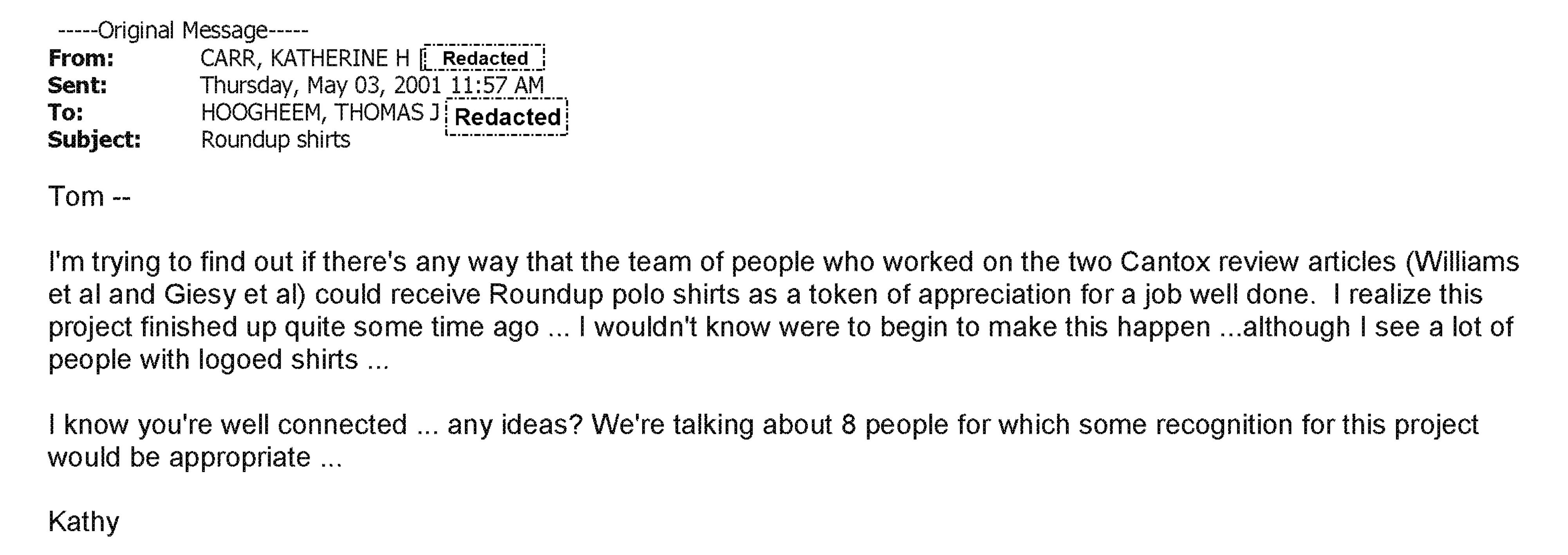
In one email from 2001, Monsanto scientist Katherine Carr asked if the “team of people” at Monsanto who worked on the Williams paper “could receive Roundup polo shirts as a token of appreciation for a job well done.”
Flawed paper was foundational for regulatory approval

While Monsanto scientists congratulated each other, glyphosate use was surging around the world; it is the most used herbicide in history. And the Williams paper played a key role in its continued acceptance as safe to use. 

“Government documents from public health agencies around the world … cite this ghostwritten paper without caveat even after the 2017 revelations, affecting policy and shaping public perception of glyphosate’s safety,” wrote researcher Alexander Kaurov and Harvard historian Naomi Oreskes in an August article in Undark.

The ghostwritten paper “exerted considerable influence over two decades, shaping public understanding, scientific discourse and policy decisions,” Kaurov and Oreskes wrote in a September 2025 paper examining the influence of the now-retracted work. 

The ghostwritten paper is in the top 0.1% of citations among academic papers discussing glyphosate, they found in their review; and the vast majority of policy and governance documents citing the paper “referenced it uncritically.” 

These findings “underscore the need for stricter journal policies to screen and retract ghostwritten papers, in order to safeguard science integrity, as well as public health and safety,” Kaurov and Oreskes wrote. 

So why did Regulatory Toxicology and Pharmacology wait until November 2025 to retract the paper? 

Editor-In-Chief van den Berg, who has been the journal’s top editor since 2019 and is based in the Netherlands, told U.S. Right to Know via email: “it simply never ended (up) on my desk being at first primarily a U.S. situation with litigation. The paper of Oreskes triggered it this summer and these authors made an official request and complaint.” 

He added, “If you have more papers regarding roundup published in RTP with possible problems, let me know.”

Longstanding problems at journal undermine regulatory system

The retraction exposes the flaws of a regulatory system that relies heavily on corporate research, and an academic publishing system that is often used as a tool for corporate product defense.

Regulatory Toxicology and Pharmacology, which is the journal of the International Society of Regulatory Toxicology and Pharmacology, has a “long, and damning history,” wrote journalist Paul Thacker in a 2017 article in Pacific Standard. He called RTP “the academic journal that corporations love.” David Michaels, a former head of the Occupational Safety and Health Administration, and a public health scientist who studies corporate manipulation of science, described it in the article as, “a vanity journal that publishes mercenary science created by polluters and producers of toxic chemicals to manufacture uncertainty about the science underlying public-health and environmental protections.” As far back as 2002, critics complained about conflicts of interest at the journal, lack of transparency, poor editorial oversight and a bias in favor of industry. 

But the problem goes deeper than one journal, as Thacker noted: “Corporations regularly buy academics to do their bidding, recasting industry talking points to create the beginnings of an alternative scientific canon.”

In the case of glyphosate, researchers and journalists have documented at length the many ways Monsanto manipulated the scientific record, influenced regulatory agencies, interfered in the peer-review process and used deceptive tactics to shape how regulators and the public view glyphosate. 

Our own examination of the Monsanto Papers, published in the 2022 Merchants of Poison report, details how Monsanto and Bayer (which purchased Monsanto in 2018) used academics as a key part of their product-defense strategy for glyphosate, and paid front groups and other allies to attack journalists and scientists who raised concerns about glyphosate.

Bayer seeks reprieve

The retraction of a “hallmark paper in the discourse surrounding the carcinogenicity of glyphosate and Roundup,” as van den Burg described it, comes as Bayer is pleading for help from politicians and courts in its bid to evade liability in thousands of lawsuits brought by farmers and groundskeepers who claim glyphosate-based Roundup weedkiller caused them to develop cancer.

On Dec. 2, President Donald Trump’s administration stepped in to help Bayer, urging the U.S. Supreme Court to review the company’s immunity plea. The Department of Justice filed a brief arguing that people shouldn’t be able to sue Bayer in state courts for failure to warn them about the cancer risk of glyphosate-based Roundup herbicides. The news pushed Bayer’s shares to the highest level in more than two years.

The administration’s position has angered many supporters of Trump’s “Make America Healthy Again” (MAHA) constituency. “A deep betrayal today,” wrote Kelly Ryerson, who writes under the name Glyphosate Girl, posted on Instagram. “Why does every single administration continue to commit to poisoning us? …  Don’t these people have families themselves?”  


Original:

Sunday, 5 October 2025

What Big Ag doesn’t want you to know about GMOs and glyphosate


For anyone even mildly tuned in to the food movement, Monsanto (now Bayer) and other ag companies have shaped the global industrial food system with GMOs and glyphosate (Roundup). Now they’re using “gene editing” to further shape nature. Behind the marketing slogans of “precision” and rising to the challenge of “feeding the world,” a different story emerges — one of regulatory capture, hidden side effects, and a food supply increasingly engineered in ways most people never see, can’t really taste, but feel distinctly in their health.
• The incalculable risk of releasing engineered organisms into nature with no recall button
In this interview, Jeffrey Smith, founder of the Institute for Responsible Technology, explains:
• Why gene-edited foods don’t need to be labeled or safety-tested before hitting the grocery shelves (and that we’re probably eating them now!)
• How gene editing like CRISPR can unleash “surprise side effects”
• Why glyphosate became one of the most widely used and controversial chemicals on earth
• The lawsuits, cover-ups, and regulatory failures surrounding Monsanto, now Bayer, products

This conversation pulls back the curtain on the experimentation on our food supply, and what you can do right now to protect your family’s health and avoid stealth GMOs.

Disclaimer:
*This interview is for educational and documentary purposes. It presents opinions and ongoing scientific debates. It is not medical advice. For health decisions, consult a qualified clinician.*

Related links:
Institute for Responsible Technology: https://responsibletechnology.org
Secret Ingredients film: https://secretingredientsfilm.com

About Collapse Life
Read more at https://www.collapselife.com and join our newsletter.

Friday, 26 June 2015

Why are we being fed by a poison expert?


Monsanto now has control over as much as 90 percent of seed genetics on the planet.

Why does this matter? Watch this humorous, entertaining, and chillingly accurate 5-minute video to find out. Then tell everyone you know.

Want to take action? Share this video! And if you want to go further, you can join the Food Revolution Network’s Campaign, calling on Coca-Cola to stop fighting GMO labeling.

Coke says it supports transparency and consumer empowerment. But last year, the company spent more than $2 million fighting against labeling of genetically engineered foods in Oregon and Colorado.


Source:
http://foodrevolution.org/blog/monsanto-gmos-video/

Saturday, 22 November 2014

Poison on the Platter

By The Institue for Responsible Technology

Bollywood filmmaker superstar Mahesh Bhatt launches a scathing attack on biotech multinational companies and compliant government regulators, showing how their dangerous genetically engineered foods and crops comprise one of the greatest dangers on earth. Released in February 2008, the hard-hitting Poison on the Platter is generating unprecedented fervor against genetically modified organisms (GMOs) throughout India. It is probably the most talked about film in the country.

Mahesh Bhatt says, “in their mad rush to capture the multi-billion dollar Indian agricultural and food industry, the biotech multinational companies are bulldozing warnings by scientists about the adverse impact of GM foods on health and environment, and hurtling the mankind toward a disaster, which will be far more destructive than anything the world has seen so far, simply because it will affect every single person living on this planet”.

Bhatt’s film makes a mockery of Government of India’s claim of not allowing import of any GM foods in the country as it conclusively demonstrates that supermarkets in India are flooded with harmful food stuff and biotech MNCs are cashing on the ignorance of unsuspecting consumers in India.

Trials of GM foods on lab animals across the world have repeatedly shown that they cause bleeding stomachs, and adversely affect brain, lungs, liver, kidney, pancreas and intestine. They have been even linked to higher offspring mortality and causing infertility.

“Are we ready to eat a food that has the potential to stunt our growth, impair our immune system and adversely affect all our vital organs,” asks Ajay Kanchan, director of the documentary, adding that “It’s shocking that instead of protecting the interests of farmers and consumers, regulatory bodies in India are pandering to the greed of biotech MNCs like Monsanto, whose track record is littered with lies, deceptions and notorious ability to corrupt the regulatory bodies all over the world”.

“I can say with absolute confidence that there is irrefutable and overwhelming evidence that genetically engineered foods are harmful and that they are not being evaluated properly by the governments of India, United States, the European Union, or anywhere in the world,” says Jeffrey M. Smith, Founder Director, Institute of Responsible Technology and author of two widely respected books on health impact of GM foods – Seeds of Deception and Genetic Roulette. He added, “this is one of the most dangerous technologies ever introduced on earth, and it’s being deployed in our food supply. It’s madness, what we need is a political willingness to say no more.”

Sunday, 31 August 2014

GMO whistleblower Dr. Thierry Vrain unveils insider information on engineered food


Thierry Vrain retired 10 years ago after a long career as a soil biologist and ended head of a department of molecular biology running his own research program to engineer nematode resistance genes in crops. In his retirement career as a gardener he learned five or six years ago how the soil ecosystem really functions and have been preaching ever since. He find himself with a good knowledge of genetic engineering technologies surrounded by people in fear of being hurt by the food they eat. He found that he cannot ignore them anymore and has joined the campaign to educate consumers about the potential health problems reported in the recent scientific literature.

Saturday, 2 November 2013

Genetic Roulette -- The Gamble of Our Lives

Genetic Roulette (2012) documentary is an investigation into the deteriorating health of Americans. Evidence put forth suggests that allowing genetically modified organisms to enter the food supply is to blame.
(Watch these documentaries while you still can. A lot of documentaries are removed from the "cancer" cathegorie as well. I spent considerable time to find and repost them from elsewhere.) 


Friday, 17 May 2013

Validated Independent News: Human Health

By Project Censored

Campaign to Fluoridate America Corporate media obscure an ongoing battle over water fluoridation in the U.S. While a recent New York Times editorial cites the Center for Disease Control’s claim that fluoridation is one of the top accomplishments in public health over the past century, James Tracy reports that fluoridating the nation’s water supply appears to have been a carefully coordinated plan designed to shield major aluminum and steel producers from liabilities for the substantial fluorine pollution their plants generated. Thus American industrial interests, supported by public relations firms, have been the chief forces behind water fluoridation.

Cow Hormones in Water Supply A May 2012 study published by the journal Environmental Science & Technology reported that large dairy farms are a “primary source” of estrogen contamination in the environment. Researchers found three primary estrogens in the wastewater, and further analysis revealed that, because of the rapid conversion from one form estrogen to another, these hormones do not degrade, but persist in the environment.

Potential of African-led Health Research A 2011 study conducted by the World Health Organization (WHO), the World Bank and USAid found that investing an additional $21-$36 per person on healthcare in sub-Saharan Africa would save more than 3 million lives in the year 2015. 90% of those saved would be women and children. Such an investment would also generate $100 billion in economic benefits.

Wireless Technology a Looming Health Crisis As a multitude of hazardous wireless technologies are deployed in homes, schools and workplaces, government officials and industry representatives continue to insist on their safety despite growing evidence to the contrary. A major health crisis looms that is only hastened through the extensive deployment of “smart grid” technology.

Corporate Hypocrisy in Fight against Breast Cancer Each year in October, corporations such as General Mills and Johnson & Johnson adorn their products in pink to raise awareness and money for breast cancer research; however, many of these companies’ products contain cancer-linked chemicals and toxins. As Brittany Shoot reports, “Food manufacturing giants use packaging full of cancer-linked chemicals, yet partner with breast cancer organizations to funnel money toward research.” This “pink washing” may distract consumers from how these companies actual contribute to the problem.

U.S. Health Law May Curb Rising Maternal Deaths America’s mothers are dying in increasing numbers. The U.S. had the highest rate of maternal mortality of all developed nations in 2009 with 16.1 maternal deaths per 100,000 live births, an increase from 6.6 deaths per 100,000 live births in 1987, according to the U.S Department of Health and Human Services. Definitive explanations for the rising maternal mortality rate are lacking, but some evidence suggests that hew health care laws, improving preventative care for pregnant women, could contribute to reversing the trend.

Should Childhood Vaccination be Mandatory? Childhood vaccines killed or injured 2,699 children last year in America, the US government has admitted – and 101 children developed autism after vaccination, even though researchers continue to insist that no link exists. Paul Offit advocates that, although vaccines are not free of risk, their benefits clearly outweigh their risks. If parents were well informed, they would choose to vaccinate their children. 

Missing Medicines in Malawi Malawi suffers from shortages of essential drugs. A 2012 Oxfam report found that only nine percent of local health facilities (54 of 585) had the full Essential Health Package list of drugs for treating 11 common diseases. 

China Acknowledges “Cancer Villages” In February 2013, China’s environmental ministry officially acknowledged the presence of cancer hot spots, known informally as “cancer villages,” throughout the country. Chinese media have reported 459 “cancer villages” throughout China, in every province and autonomous region except Qinghai and Tibet. Once a rare disease, cancer is now the biggest killer in both urban and rural China, with mortality rates as high as 80 percent in the last 30 years.

The Drugs in US Meat–We’re Eating What? Synthetic growth hormones routinely administered in the US to livestock are not listed on food package labels. Other drugs used to increase muscle mass in pigs and turkeys, including ractopamine, have been banned in 160 but remain in use in the US. A European scientific commission believes there is an association between steroid hormones and cancers, including breast and prostate cancers, and that meat consumption is the culprit. The US has the highest rates of both and also uses the most hormones in its meat production. Since 1989, Europe has banned most US meat.

Genital Mutilation in the US Although genital mutilation is concentrated in Africa, Asia and the Middle East, thousands of US girls living in immigrant communities are sent out of the country to places where genital mutilation is practiced, or relatives from practicing counties come to the US to do the procedure. The New York metropolitan area has the highest cases of female genital mutilation in the US; approximately 41,000 cases. These women face major complications to their health, including infections, post-traumatic stress disorder and painful menstruation cycles.

Routine Infant Circumcision: Exempt from American Medical Ethics The US is the only country in the world that circumcises male infants for non-religious reasons. This pro-circumcision bias of American culture is reflected in medical theory and policy. However, most proponents lack awareness of the health impact of circumcision.

South Africa “Over 25% Schoolgirls HIV Positive” About five million people in South Africa are HIV positive, which is about 10% of the total population. Those numbers are higher when looking at the school-age female population. Over 25% of school-aged girls are HIV positive, some as young as 10 years old. Many contract HIV as a result of sexual relations with older “sugar-daddies.” 


Private equity (PE) firms are targeting the US health-care providers. Growing PE interest in low profit or non-profit sectors like hospitals is expanding. PE investors are betting on new profit opportunities from the growing needs of the baby-boomer generation and from the Affordable Care Act, which will dramatically expand health-insurance coverage.

Federally Funded Health-Care Co-ops —Coming to Your Community With funding from the Affordable Care Act (ACA), communities are coming together to develop Consumer Operated and Oriented Plans—CO-Ops to operate community health care facilities or cooperative insurance plans. Unlike private health insurance companies, these co-ops are owned and democratically controlled by their members. Beginning in 2014, a first wave of co-ops will launch in 24 states, with an estimated 19 million previously uninsured Americans expected to use insurance exchanges to buy health coverage.

The US has left Iraq with an Epidemic of Cancers and Birth Defects After ten years of war in Iraq, Dahr Jamail reports, the US has left Iraq (and especially the city of Fallujah) with a rising epidemic of toxic contamination. After the US military used depleted uranium munitions in 2004, Iraqi medical officials have tracked twice number of cancer cases as in 1995.

Mozambique’s First HIV Vaccine Trial Heralds New Era in Local Research Mozambique’s Polana Cancio Centre for Research and Public Health has finished its first HIV vaccine trial and is preparing to start the second trial. According to the preliminary test, the vaccine is safe for use. According to Ilesh Jani, the studies mark an important step towards bolstering clinical trial and research capacity for diseases such as HIV and malaria. One goal of this research is to develop a vaccine that will be affordable in countries such as Mozambique.

Skyrocketing HIV/AIDS Rates in African American Women In August 2012 at the International AIDS Conference in Washington DC, HIV advocates met to discuss the skyrocketing HIV infection rates in black women that are increasing to levels found in sub-Sahara Africa. The recent growth in HIV cases among African-American women especially among youth has public health professionals concerned. In 2010, black women contracted 44 percent of new HIV infections. 

Background TV Poses Danger for Children A recent study conducted at the University of North Carolina, Wilmington (UNCW) sheds new light on the detrimental impact background television has on children’s neural development and social skills. The UNCW study shows that children exposed to more TV are more likely to develop problems with hyperactivity and antisocial behavior. When children accustomed to such high doses of daily television stop watching all together, depression has a tendency to develop.

US Veterans Prescribed Lethal Drugs to Treat PTSD A number of US war veterans were issued a variety of potentially deadly pharmaceuticals to treat post-traumatic stress disorder (PTSD) including the dangerous antipsychotic drug Seroquel. Pleas from the families of deceased veterans finally persuaded the U.S. Central Command to remove the dangerous antipsychotic from the list of military PTSD treatments. Information about Seroquel and similar drugs is often kept hidden from the public, leaving consumers of generic brands unaware of corporate deceit and veteran deaths.

Antidepressant Drugs Pose Serious Health Concerns for Unborn Babies The world’s largest drug companies are encouraging pregnant women to take prescription drugs, get vaccine shots, and even have chemotherapy. Among these are selective serotonin reuptake inhibitors (SSRIs) or antidepressants, which are causing miscarriages and a variety of birth defects. Excessive prescription drug use in pregnant women is also linked to the increase of babies born with autism, preterm birth, newborn behavioral syndrome, persistent pulmonary hypertension of the newborn and longer-term neurobehavioral effects.

Pesticides May Lead to Cancer and Autism in Children Pesticides are harmful to the health and intelligence of America’s children, according to an October 2012 report released by the Pesticide Action Network of North America. Titled, “A Generation in Jeopardy,” the study notes how chemicals from pest control products are one key cause of a range of disorders such as ADHD, autism, cancer, disrupted metabolism, and even low IQs.

Laboratory Study of Rats Supports Dangers of GM Corn A study published in September issue of The Food & Chemical Toxicology Journal found that rats fed Monsanto’s genetically modified corn over several months showed significant health problems including premature death and tumors. The study found that over half of the male rats and 70 percent of the females who were fed a lifetime of Monsanto’s corn died prematurely with significant liver and kidney damage. Scientists also found the rats to contain cancerous tumors so large they blocked organ function. While numerous studies have examined their short-term impact, this is the first ever study to examine the long-term effects of GMO consumptions.

Project Censored
The News That Didn't Make The News

Eighteen college and universities worldwide have researched and validated 233 independent news stories for the annual Project Censored review cycle. These independent news stories have seen little if any coverage by the corporate media. The Project Censored network is currently voting on the top 25 most important stories for inclusion in Censored 2014: Fearless Speech in Fateful Times, the latest edition of our annual yearbook, scheduled for release by Seven Stories Press in October 2013. 

Please help us maintain this annual process by becoming a subscriber ($5-$10 a month) or by making a one time tax deductible donation of support here.

We thank you for your support and please review the latest Validated Independent News stories on Human Health.

Sincerely,

Mickey Huff—Director of Project Censored

Andy Roth—Associate Director of Project Censored

Peter Phillips—President, Media Freedom Foundation/Project Censored

http://www.projectcensored.org/

Wednesday, 1 May 2013

How Americans Became Exposed to Biohazards in the Greatest Uncontrolled Experiment Ever Launched

Truthout


A hidden epidemic is poisoning America. The toxins are in the air we breathe and the water we drink, in the walls of our homes and the furniture within them. We can’t escape it in our cars. It’s in cities and suburbs. It afflicts rich and poor, young and old. And there’s a reason why you’ve never read about it in the newspaper or seen a report on the nightly news: it has no name -- and no antidote. 

The culprit behind this silent killer is lead. And vinyl. And formaldehyde. And asbestos. And Bisphenol A. And polychlorinated biphenyls (PCBs). And thousands more innovations brought to us by the industries that once promised “better living through chemistry,” but instead produced a toxic stew that has made every American a guinea pig and has turned the United States into one grand unnatural experiment.

Today, we are all unwitting subjects in the largest set of drug trials ever. Without our knowledge or consent, we are testing thousands of suspected toxic chemicals and compounds, as well as new substances whose safety is largely unproven and whose effects on human beings are all but unknown. The Centers for Disease Control (CDC) itself has begun monitoring our bodies for 151 potentially dangerous chemicals, detailing the variety of pollutants we store in our bones, muscle, blood, and fat. None of the companies introducing these new chemicals has even bothered to tell us we’re part of their experiment. None of them has asked us to sign consent forms or explained that they have little idea what the long-term side effects of the chemicals they’ve put in our environment -- and so our bodies -- could be. Nor do they have any clue as to what the synergistic effects of combining so many novel chemicals inside a human body in unknown quantities might produce.

How Industrial Toxins Entered the American Home

The story of how Americans became unwitting test subjects began more than a century ago. The key figure was Alice Hamilton, the “mother” of American occupational medicine, who began documenting the way workers in lead paint pigment factories, battery plants, and lead mines were suffering terrible palsies, tremors, convulsions, and deaths after being exposed to lead dust that floated in the air, coating their workbenches and clothes.

Soon thereafter, children exposed to lead paint and lead dust in their homes were also identified as victims of this deadly neurotoxin. Many went into convulsions and comas after crawling on floors where lead dust from paint had settled, or from touching lead-painted toys, or teething on lead-painted cribs, windowsills, furniture, and woodwork.

Instead of leveling with the public, the lead industry through its trade group, the Lead Industries Association, began a six-decade-long campaign to cover-up its product’s dire effects. It challenged doctors who reported lead-poisoned children to health departments, distracted the public through advertisements that claimed lead was “safe” to use, and fought regulation of the industry by local government, all in the service of profiting from putting a poison in paint, gasoline, plumbing fixtures, and even toys, baseballs, and fishing gear. 

As Joe Camel would be for tobacco, so the little Dutch Boy of the National Lead Company became an iconic marketing tool for Dutch Boy Lead Paint, priming Americans to invite a dangerous product into their children’s playrooms, nurseries, and lives. The company also launched a huge advertising campaign that linked lead to health, rather than danger. It even produced coloring books for children, encouraging them to paint their rooms and furniture using lead-based paint.

Only after thousands of children were poisoned and, in the 1960s, activist groups like the Young Lords and the Black Panthers began to use lead poisoning as a symbol of racial and class oppression did public health professionals and the federal government begin to rein in companies like the Sherwin-Williams paint company and the Ethyl Corporation, which produced tetraethyl lead, the lead-additive in gasoline. In 1971, Congress passed the Lead Paint Poisoning Prevention Act that limited lead in paint used for public housing. In 1978, the Consumer Products Safety Commission finally banned lead in all paints sold for consumer use. During the 1980s, the Environmental Protection Agency issued rules that led to the elimination of leaded gasoline by 1995 (though it still remains in aviation fuel).

The CDC estimates that in at least 4 million households in the U.S. today children are still exposed to dangerous amounts of lead from old paint that produces dust every time a nail is driven into a wall to hang a picture, a new electric socket is installed, or a family renovates its kitchen. It estimates that more than 500,000 children ages one to five have “elevated” levels of lead in their blood. (No level is considered safe for children.) Studies have linked lost IQ points, attention deficit disorders, behavioral problems, dyslexia, and even possibly high incarceration rates to tiny amounts of lead in children’s bodies.

Unfortunately, when it came to the creation of America’s chemical soup, the lead industry was hardly alone. Asbestos is another classic example of an industrial toxin that found its way into people’s homes and bodies. For decades, insulation workers, brake mechanics, construction workers, and a host of others in hundreds of trades fell victim to the disabling and deadly lung diseases of asbestosis or to lung cancer and the fatal cancer called mesothelioma when they breathed in dust produced during the installation of boilers, the insulation of pipes, the fixing of cars that used asbestos brake linings, or the spraying of asbestos on girders. Once again, the industry knew its product’s dangers early and worked assiduously to cover them up.

Despite growing medical knowledge about its effects (and increasing industry attempts to downplay or suppress that knowledge), asbestos was soon introduced to the American home and incorporated into products ranging from insulation for boilers and piping in basements to floor tiles and joint compounds. It was used to make sheetrock walls, roof shingles, ironing boards, oven gloves, and hot plates. Soon an occupational hazard was transformed into a threat to all consumers.

Today, however, these devastating industrial-turned-domestic toxins, which destroyed the health and sometimes took the lives of hundreds of thousands, seem almost quaint when compared to the brew of potential or actual toxins we’re regularly ingesting in the air we breathe, the water we drink, and the food we eat. 

Of special concern are a variety of chlorinated hydrocarbons, including DDT and other pesticides that were once spread freely nationwide, and despite being banned decades ago, have accumulated in the bones, brains, and fatty tissue of virtually all of us. Their close chemical carcinogenic cousins, polychlorinated biphenyls (PCBs), were found in innumerable household and consumer products -- like carbonless copy paper, adhesives, paints, and electrical equipment – from the 1950s through the 1970s. We’re still paying the price for that industrial binge today, as these odorless, tasteless compounds have become permanent pollutants in the natural environment and, as a result, in all of us.

The Largest Uncontrolled Experiment in History

While old houses with lead paint and asbestos shingles pose risks, potentially more frightening chemicals are lurking in new construction going on in the latest mini-housing boom across America. Our homes are now increasingly made out of lightweight fibers and reinforced synthetic materials whose effects on human health have never been adequately studied individually, let alone in the combinations we’re all subjected to today. 

Formaldehyde, a colorless chemical used in mortuaries as a preservative, can also be found as a fungicide, germicide, and disinfectant in, for example, plywood, particle board, hardwood paneling, and the “medium density fiberboard” commonly used for the fronts of drawers and cabinets or the tops of furniture. As the material ages, it evaporates into the home as a known cancer-producing vapor, which slowly accumulates in our bodies. The National Cancer Institute at the National Institutes of Health suggests that homeowners “purchasing pressed-wood products, including building material, cabinetry, and furniture... should ask about the formaldehyde content of these products.”

What’s inside your new walls might be even more dangerous. While the flame retardants commonly used in sofas, chairs, carpets, love seats, curtains, baby products, and even TVs, sounded like a good idea when widely introduced in the 1970s, they turn out to pose hidden dangers that we’re only now beginning to grasp. Researchers have, for instance, linked one of the most common flame retardants, polybrominated diphenyl ethers, to a wide variety of potentially undesirable health effects including thyroid disruption, memory and learning problems, delayed mental and physical development, lower IQ, and the early onset of puberty.

Other flame retardants like Tris (1,3-dichloro-2-propyl) phosphate have been linked to cancer. As the CDC has documented in an ongoing study of the accumulation of hazardous materials in our bodies, flame retardants can now be found in the blood of “nearly all” of us. 

Nor are these particular chemicals anomalies. Lurking in the cabinet under the kitchen sink, for instance, are window cleaners and spot removers that contain known or suspected cancer-causing agents. The same can be said of cosmetics in your makeup case or of your plastic water bottle or microwavable food containers. Most recently, Bisphenol A (BPA), the synthetic chemical used in a variety of plastic consumer products, including some baby bottles, epoxy cements, the lining of tuna fish cans, and even credit card receipts, has been singled out as another everyday toxin increasingly found inside all of us. 

Recent studies indicate that its effects are as varied as they are distressing. As Sarah Vogel of the Environmental Defense Fund has written, “New research on very-low-dose exposure to BPA suggests an association with adverse health effects, including breast and prostate cancer, obesity, neurobehavioral problems, and reproductive abnormalities.” 

Teflon, or perfluorooctanoic acid, the heat-resistant, non-stick coating that has been sold to us as indispensable for pots and pans, is yet another in the list of substances that may be poisoning us, almost unnoticed. In addition to allowing fried eggs to slide right onto our plates, Teflon is in all of us, according to the Science Advisory Board of the Environmental Protection Agency, and “likely to be carcinogenic in humans.”

These synthetic materials are just a few of the thousands now firmly embedded in our lives and our bodies. Most have been deployed in our world and put in our air, water, homes, and fields without being studied at all for potential health risks, nor has much attention been given to how they interact in the environments in which we live, let alone our bodies. The groups that produce these miracle substances -- like the petrochemical, plastics, and rubber industries, including major companies like Exxon, Dow, and Monsanto -- argue that, until we can definitively prove the chemical products slowly leaching into our bodies are dangerous, we have no “right,” and they have no obligation, to remove them from our homes and workplaces. The idea that they should prove their products safe before exposing the entire population to them seems to be a foreign concept.

In the 1920s, the oil industry made the same argument about lead as an additive in gasoline, even though it was already known that it was a dangerous toxin for workers. Spokesman for companies like General Motors insisted that it was a “gift of God,” irreplaceable and essential for industrial progress and modern living, just as the lead industry argued for decades that lead was “essential” to produce good paint that would protect our homes.

Like the oil, lead, and tobacco industries of the twentieth century, the chemical industry, through the American Chemistry Council and public relations firms like Hill & Knowlton, is fighting tooth and nail to stop regulation and inhibit legislation that would force it to test chemicals before putting them in the environment. In the meantime, Americans remain the human guinea pigs in advanced trials of hundreds if not thousands of commonly used, largely untested chemicals. There can be no doubt that this is the largest uncontrolled experiment in history. 

To begin to bring it under control would undoubtedly involve major grassroots efforts to push back against the offending corporations, courageous politicians, billions of dollars, and top-flight researchers. But before any serious steps are likely to be taken, before we even name this epidemic, we need to wake up to its existence. 

A toxic dump used to be a superfund site or a nuclear waste disposal site. Increasingly, however, we -- each and every one of us -- are toxic dumps and for us there’s no superfund around, no disposal plan in sight. In the meantime, we’re walking, talking biohazards and we don’t even know it.To stay on top of important articles like these, sign up to receive the latest updates from TomDispatch.com here

Tuesday, 9 April 2013

Argentina - A Poster Child for the Health Hazards of GMO Crops

By Dr Mercola

Argentina’s population is being sickened by massive spraying of herbicides on its genetically engineered soya fields. Glyphosate, the main ingredient in Roundup, is blamed for the dramatic increase in devastating birth defects as well as cancer. Sterility and miscarriages are also increasing.

A 2012 nutritional analysis of GMO versus non-GMO corn shows shocking differences in nutritional content. Non-GMO corn contains 437 times more calcium, 56 times more magnesium, and 7 times more manganese than GMO corn.

GMO corn was also found to contain 13 ppm of glyphosate, compared to zero in non-GMO corn. The EPA standard for glyphosate in American water supplies is 0.7 ppm, and organ damage in animals has occurred at levels as low as 0.1 ppm.

GMO corn contains extremely high levels of formaldehyde—about 200 times the amount found toxic to animals.

Unfortunately, President Obama recently signed into law a spending bill that included a devastating provision that puts Monsanto above the law. The provision limits the ability of judges to stop Monsanto and/or farmers from growing or harvesting genetically engineered crops, even if courts find evidence of potential health risks.

Source and more info here.

Sunday, 3 March 2013

Paul Craig Roberts: Polluted America - GMO Manmade Biological Threats, Plant Diseases, Germ Warfare‏

Global Research, February 26, 2013
Url of this article:

In the United States everything is polluted.

Democracy is polluted with special interests and corrupt politicians.

Accountability is polluted with executive branch exemptions from law and the Constitution and with special legal privileges for corporations, such as the Supreme Court given right to corporations to purchase American elections.

The Constitution is polluted with corrupt legal interpretations from the Bush and Obama regimes that have turned constitutional prohibitions into executive branch rights, transforming law from a shield of the people into a weapon in the hands of government.

Waters are polluted with toxic waste spills, oil spills, chemical fertilizer run-off with resulting red tides and dead zones, acid discharges from mining with resulting destructive algae such as prymnesium parvum, from toxic chemicals used in fracking and with methane that fracking releases into wells and aquifers, resulting in warnings to homeowners near to fracking operations to open their windows when showering.

The soil’s fertility is damaged, and crops require large quantities of chemical fertilizers. The soil is polluted with an endless array of toxic substances and now with glyphosate, the main element in Monsanto’s Roundup herbicide with which GMO crops are sprayed.
Glyphosate now shows up in wells, streams and in rain.

Air is polluted with a variety of substances, and there are many large cities in which there are days when the young, the elderly, and those suffering with asthma are warned to remain indoors.

All of these costs are costs imposed on society and ordinary people by corporations that banked profits by not having to take the costs into account. This is the way in which unregulated capitalism works.

Our food itself is polluted with antibiotics, growth hormones, pesticides, and glyphosate.

Glyphosate might be the most dangerous development to date. Some scientists believe that glyphosate has the potential to wipe out our main grain crops and now that Obama’s Secretary of Agriculture, Thomas Vilsack, has approved genetically modified Roundup Ready alfalfa, maintaining sustainable animal herds for milk and meat could become impossible.

Alfalfa is the main forage crop for dairy and beef herds. Genetically modified alfalfa could be unsafe for animal feed, and animal products such as milk and meat could become unsafe for human consumption.

On January 17, 2011, Dr. Don Huber outlined the dangers of approving Roundup Ready alfalfa in a letter to Secretary of Agriculture Vilsack. Huber requested that approval be delayed until independent research could evaluate the risks. Vilsack ignored the letter and accommodated Monsanto’s desire for monopoly profits that come from the company’s drive to control the seed supply of US and world agriculture by approving Roundup Ready alfalfa.

Who is Don Huber, and why is his letter important?

Huber is professor emeritus at Purdue University. He has been a plant pathologist and soil microbiologist for a half century. He has an international reputation as a leading authority. In the US military, he evaluated natural and manmade biological threats, such as germ warfare and disease outbreaks and retired with the rank of Colonel. For the USDA he coordinates the Emergent Diseases and Pathogens Committee. In other words, he is high up in his scientific profession.

You can read online what Huber told the Secretary of Agriculture. Briefly, the outcome of many years of Roundup Ready GMO corn and soybeans has been a decline in nutritional value, the outbreak of new plant diseases resulting in widespread crop failures, and severe reproductive problems in livestock, with some herds having a spontaneous abortion rate that is too high to maintain a profitable business.

Glyphosate is a powerful biocide. It harms beneficial soil organisms, altering the natural balance in the soil and reducing the disease resistance of crops, thus unleashing diseases that devastate corn, soybean, and wheat crops, and giving rise to a new pathogen associated with premature animal aging and infertility. These developments, Huber told the Agriculture Secretary, “are threatening the economic viability of both crop and animal producers.” The evidence seems to be real that genetically modified crops have lost their genetic resistance to diseases that never previously were threats.

There is evidence that the new pathogen is related to a rise in human infertility and is likely having adverse effects on human health of which we are still uninformed. Like fluoride, glyphosate might enter our diet in a variety of ways. For example, the label on a bottle of Vitamin D says, “Other ingredients: soybean oil, corn oil.”

Monsanto disputes Huber’s claims and got support for its position from the agricultural extension services of Iowa State and Ohio State universities. However, the question is whether these are independently funded services or corporate supported, and there is always the element of professional rivalry, especially for funding, which comes mainly from agribusiness.

The Purdue University extension service was more circumspect. On the one hand it admits that there is evidence that supports Huber’s claims: “The claim that herbicides, such as glyphosate, can make plants more susceptible to disease is not entirely without merit. Research has indicated that plants sprayed with glyphosate or other herbicides are more susceptible to many biological and physiological disorders (Babiker et al., 2011; Descalzo et al., 1996; Johal and Rahe, 1984; Larson et al., 2006; Means and Kremer, 2007; Sanogo et al., 2000; Smiley et al., 1992). . . . Although some research indicates there is an increase in disease severity on plants in the presence of glyphosate, it does NOT necessarily mean that there is an impact on yield.”

On the other hand, the Purdue extension service maintains its recommendation for “judicious glyphosate use for weed control.” However, one of Huber’s points is that weeds are developing Roundup resistance. Use has gone beyond the “judicious” level and as glyphosate builds up in soil, its adverse effects increase.

A submission to the Environmental Protection Agency by 26 university entomologists describes the constraints that agribusiness has put on the ability of independent scientists to conduct objective research. The submission, in which the scientists are afraid to reveal their names because of the threat of funding cutoffs, is included as an item in one of the bibliographical references below. Here is the statement:

“The names of the scientists have been withheld from the public docket because virtually all of us require cooperation from industry at some level to conduct our research. Statement: Technology/stewardship agreements required for the purchase of genetically modified seed explicitly prohibit research. These agreements inhibit public scientists from pursuing their mandated role on behalf of the public good unless the research is approved by industry. As a result of restricted access, no truly independent research can be legally conducted on many critical questions regarding the technology, its performance, its management implications, IRM, and its interactions with insect biology. Consequently, data flowing to an EPA Scientific Advisory Panel from the public sector is unduly limited.”

Monsanto is not only sufficiently powerful to prevent any research other than that which it purchases with its funding, but also Monsanto succeeded last year in blocking with money and propaganda the GMO labeling law in California. I would tell you to be careful what you eat as it can make you ill and infertile, but you can’t even find out what you are eating.

You live in America, which has “freedom and democracy” and “accountable” government and ”accountable” corporations. You don’t need to worry. The government and responsible corporations are taking good care of you. Especially Obama, Vilsack, and Monsanto.

Short bibliography:

http://fhr.branditimage.com/hot-topic-letter-to-us-secretary-of-agriculture/

http://www.fooddemocracynow.org/blog/2011/apr/6/don-hubers-cover-letter-euuk-commissions/

http://www.greenpasture.org/utility/showArticle/?objectID=7169

http://ourecovillage.org/2011/04/11/dr-hubers-cover-letter-to-secretary-vilsack/

http://www.gmwatch.org/latest-listing/51-2012/14164-glyphosate-and-gmos-impact-on-crops-soils-animals-and-man-dr-don-huber

http://www.non-gmoreport.com/articles/may10/consequenceso_widespread_glyphosate_use.php

http://www.monsanto.com/newsviews/Pages/huber-pathogen-roundup-ready-crops.aspx

http://southeastfarmpress.com/resistant-pigweed-plagues-central-georgia-cotton

http://www.foodandwaterwatch.org/blogs/time-for-usda-to-wake-up-to-weed-resistance-and-ban-agent-orange-corn-once-and-for-all/

http://southeastfarmpress.com/resistant-pigweed-plagues-central-georgia-cotton

http://www.foodandwaterwatch.org/blogs/time-for-usda-to-wake-up-to-weed-resistance-and-ban-agent-orange-corn-once-and-for-all/

Copyright © 2013 Global Research