Showing posts with label gold. Show all posts

Monday, 12 November 2012

China and Russia are Acquiring Gold, Dumping US Dollars

Global Research, November 11, 2012

Url of this article:

There is evidence that central banks in several regions of the World are building up their gold reserves. What is published are the official purchases.

A large part of these Central Bank purchases of gold bullion are not disclosed. They are undertaken through third party contracting companies, with utmost discretion.

US dollar holdings and US dollar denominated debt instruments are in effect being traded in for gold, which in turn puts pressure on the US dollar.

In turn, both China and Russia have boosted domestic production of gold, a large share of which is being purchased by their central banks:

It has long been assumed that China is surreptitiously building up its gold reserves through buying local production. Russia is another major gold miner where the Central bank has been purchasing gold from another state entity, Gokhran, which is the marketing arm and central repository for the country’s mined gold production. Now it has been reported by Bloomberg that the Venezuelan Central Bank director, Jose Khan, has said that country will boost its gold reserves through purchasing more than half the gold produced from its rapidly growing domestic gold mining industry.

In Russia, for example, Gokhran sold some 30 tonnes of gold to the Central Bank in an internal accounting exercise late last year. In part, so it was said at the time, the direct sale was made rather than placing the metal on the open market and perhaps adversely affecting the gold price.

China is currently the world’s largest gold producer and last year it confirmed it had raised its own Central Bank gold holdings by more than 450 tones over the previous six years. Mineweb.com – The world’s premier mining and mining investment website Venezuela taking own gold production into Central Bank reserves – GOLD NEWS | Mineweb

The 450 tons figure corresponds to an increase in the gold reserves of the central bank from 600 tons in 2003 to 1054 tons in 2009. If we go by official statements, China’s gold reserves are increasing by approximately 10 percent per annum.

China has risen to now be the largest gold producing nation in the world at around 270 tonnes. The amount bought in by the government initially looks like 90 tonnes per annum or just under, 2 tonnes a week. Before 2003 the announcement by the Chinese central bank that gold reserves had been doubled to 600 tonnes, accounted for similar purchases before that date. Why so small an amount you may well ask? We think local and national issues clouded the central bank’s view as it was the government that bought the gold since 2003 and have now placed it on the central bank’s Balance Sheet. So we would conclude that the government has ensured central bank gold purchasing must continue. “How will Chinese Central Bank Gold Buying affect the Gold Price short & Long-Term?” by Julian Phillips. FSO Editorial 05/07/2009

Russia

Russia’s Central bank holdings are in excess of 20 million troy ounces (January 2010)


click to enlarge

Russia’s Central Bank reserves have increased markedly in recent years. The RCB reported in May 2010 purchasing 34.2 tons of gold in a single month.Russian Central Bank Gold Purchases Soar In May – China Too? | The Daily Gold

The diagram below shows a significant increase in monthly purchases by the the RCB since June 2009.


(click on chart to enlarge)

Central Banks in the Middle East are also building up their gold reserves, while reducing their dollar forex holding.

Gold reserves of GCC states is less than 5 percent:

Dubai International Financial Centre Authority economists released a report yesterday calling for local countries to build gold reserves, according to The National.

Despite a high interest in gold, GCC states maintain less than 5 percent of their total reserves in gold. Compared to the ECB, which holds 25 percent of reserves in gold, that leaves a lot of room for growth. http://www.businessinsider.com/gcc-boost-gold-holdings-2010-12#ixzz18FEqpTy3

GCC states should boost their foreign reserve holdings of gold to help shield their billions of dollars of assets from turbulence in global currency markets, say economists at the Dubai International Financial Centre Authority (DIFCA).

Diversifying more of their reserves from US dollars to the yellow metal would help to offer central banks in the region higher investment returns, said Dr Nasser Saidi, the chief economist of DIFCA, and Dr Fabio Scacciavillani, the director of macroeconomics and statistics at the authority.

“When you have a great deal of economic uncertainty, going into paper assets, whatever they may be – stocks, bonds, other types of equity – is not attractive,” said Dr Saidi. “That makes gold more attractive.”

Declines in the dollar during recent months have dented the value of GCC oil revenues, which are predominantly weighted in the greenback.GCC urged to boost gold reserves

According to a report in People`s Daily;

The latest rankings of gold reserves show that, as of mid-December, the United States remains the top country and the Chinese mainland is ranked sixth with 1,054 tons of reserves, the World Gold Council announced recently.

Russia climbed to eighth place because its gold reserves increased by 167.5 tons since December 2009. The top ten in 2010 remains the same compared to the rankings of the same period of last year. And Saudi Arabia squeezed to the top 20.

Developing countries and regions, including Saudi Arabia and South Africa, have become the main force driving the gold reserve increase. … .

The International Monetary Fund (IMF) and the European central bank are the major gold sellers, and the IMF’s gold reserves decreased by 158.6 tons. (China’s gold reserves rank 6th worldwide – People’s Daily Online

It should be understood that actual purchases of physical gold are not the only factor in explaining the movement of gold prices. The gold market is marked by organized speculation by large scale financial institutions.

The gold market is characterised by numerous paper instruments, gold index funds, gold certificates, OTC gold derivatives (including options, swaps and forwards), which play a strong role, particularly in short-term movement of gold prices. The recent increase and subsequent decline of gold prices are the result of manipulation by powerful financial actors.

Copyright © 2012 Global Research

Sunday, 4 November 2012

The Virtual Economic Recovery

Global Research, October 30, 2012
Url of this article:

Since mid-2009 the US has been enjoying a virtual recovery courtesy of a rigged inflation measure that understates inflation. The financial Presstitutes spoon out the government’s propaganda that prices are rising less than 2%. But anyone who purchases food, fuel, medical care or anything else knows that low inflation is no more real that Saddam Hussein’s weapons of mass destruction or Gadhafi’s alleged attacks on Libyan protesters or Iran’s nuclear weapons. Everything is a lie to serve the power-brokers.

During the Clinton administration, Republican economists pushed through a change in the way the CPI is measured in order to save money by depriving Social Security retirees of their cost-of-living adjustment. Previously, the CPI measured the change in the cost of a constant standard of living. The new measure assumes that consumers adjust to price increases by lowering their standard of living by substituting lower quality, lower priced items. If the price, for example, of New York strip steak goes up, consumers are assumed to substitute the lower quality round steak. In other words, the new measure of inflation keeps inflation down by reflecting a lowered standard of living.

Statistician John Williams (shadowstats.com), who closely follows the collecting and reporting of official US economic statistics, reports that consumer inflation, as measured by the 1990 official government methodology has been running at about 5%. If the 1980 official methodology for measuring the CPI is used, John Williams reports that the current rate of US inflation is about 9%.

The 9% figure is more consistent with people’s experience in grocery stores.

Officially the recession that began in 2007 ended in June 2009 after 18 months, making the Bush Recession the longest recession since World War II. However, John Williams says that the recession has not ended. He says that only the GDP reporting, distorted by an erroneous measurement of inflation, shows a recovery. Other, more reliable measures of economic activity, show no recovery.

Williams reports that the economy began turning down in 2006, falling lower in 2008 and 2009, and bottom-bouncing ever since. Not only is there no sign of any recovery, but “the economic downturn now is intensifying once again.” The absence of an economic recovery “is evident in the [official] reporting of nearly all major economic series. Not one of these series shows a pattern of activity that confirms the recovery [shown] in the GDP series.”

Williams concludes that “the official recovery simply is a statistical illusion created by the government’s use of understated inflation in deflating the GDP.” In other words, the reported gains in GDP are accounted for by price increases, not increases in real output.

The result of the US government’s economic deception is the same as the deception Washington has used to start wars all over the Middle East. The government propaganda produces a make-believe virtual reality that bears no relationship to real reality. In history there have been many governments who have prevailed by deceiving the people, but Washington has moved this success to a new peak. As long as Americans believe anything Washington says, they are doomed.

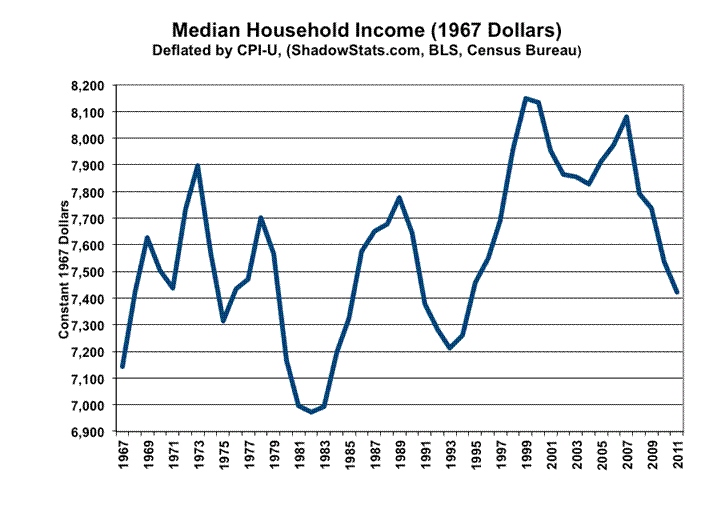
It is easy to see why there is no economic recovery and cannot be an economic recovery. Look at the chart below (courtesy of John Williams,shadowstats.com).


Real median household income at the end of 2011 is back where it was in 1967-68. Moreover, Williams has deflated household income to get its real value by using the official inflation measure, which substantially understates inflation. If Williams had used the 1990 or 1980 official government methodology for calculating the consumer price index, the real median incomes of households would show a larger decline.

Moreover, the low 2011 real median household income is the summation, in most cases, of two household earners, whereas in 1967-68 one earner could produce the same real income. As Nobel economist Gary Becker, my former colleague as Business Week columnist, pointed out, when both husband and wife have to work in order to maintain the same purchasing power, household income from the wife’s in-kind household services is eliminated. Therefore, the monetary measure of the dual household income overstates income, because it is not adjusted for the lost benefits formerly provided by the wife who at home managed the household.

Americans are far more oppressed by the power brokers in Washington than statistics display. Moreover, the young are born into the oppressive, exploitative American system and do not know any different. They are fed by the Presstitute media with endless propaganda about how fortunate they are and how indispensable their wonderful country is. Americans are kept in a constant state of amusement, and many never grasp the loss of their civil liberties, job and career opportunities, and respect that the US won during the decades-long cold war with Soviet Communism.

On September 13, Federal Reserve Chairman Ben “Helicopter” Bernanke announced Quantitative Easing 3. Bernanke said that the recovery is weak and needs more Fed stimulus. He said the Fed will purchase $40 billion of mortgage bonds per month in order to drive interest rates further below the rate of inflation and help to sell more houses.

But how do you sell houses to households who are getting by with 1967-68 levels of real income and who have absolutely no job security? Their company can be taken over and offshored tomorrow or they can be replaced by foreign workers on H-1B visas. Housing prices have dropped, but not to 1967-68 levels.

Bernanke’s announcement that the Fed’s purchase of mortgage bonds is to spur housing and the economy is disinformation. Bernanke is purchasing the bonds in order to boost the values of the derivatives and debt instruments in the banks’ portfolios. Lower interest rates raise the value of the debt instruments on the banks’ balance sheets. By depriving American savers of a real interest rate on their savings, Bernanke makes the busted banks look solvent.

This is what is happening in “freedom and democracy” America. The vast majority of Americans, especially the retired, are forced to consume their savings and draw down their capital because they can get no real interest on their savings. The beneficiaries are the banksters, who can borrow at near zero interest rates, charge consumers 16% on their credit cards, and use the Federal Reserve’s largess to speculate on interest rate swaps and credit default swaps. The American taxpayers hold the bag for the banksters’ uncovered gambles.

Would you not gamble if the American taxpayers had to cover your bets, but your winnings were yours alone?

The future of the American political order is in doubt. The Bush and Obama regimes have so badly abused the Constitution and statutory law, that the America that Ronald Reagan left to us no longer exists. America is on the path to collapse or tyranny.

Suppose that a miracle produces an economic recovery. What becomes of the enormous excess bank reserves that the Federal Reserve has provided the banks?

If these bank reserves are used for expanding loans, the money supply will outstrip the production of goods and services, and inflation will rise.

If the Fed tries to take the excess reserves out of the banking system by selling bonds, interest rates will rise, thus destroying the wealth of bond holders and draining liquidity from the stock market. In other words, another depression that wipes out the remaining American wealth.

The Federal Reserve’s announcement of QE3 shows that the Fed will continue to create new money in order to protect the values of the insolvent banks’ questionable assets. The Federal Reserve represents the banksters, not the American public. Like every other American government institution, the Federal Reserve is far removed from concerns about American citizens.

In my opinion, the Federal Reserve’s purchase of bonds in order to drive down interest rates has produced a bond market bubble that is larger than the real estate and derivative bubbles. Economically, it is nonsensical for a bond to carry a negative real interest rate, especially when the government issuing the bond is running large budget deficits that it seems unable to reduce and when the central bank is monetizing the debt.

The bubble has been protected by the euro “crisis,” which possibly is more of a virtual crisis than a real one. The euro crisis has caused money to seek refuge in dollars, thus supporting the dollar’s value even while the Federal Reserve prints money with which to purchase the never-ending flow of the governments’ bonds to finance trillion dollar plus annual budget deficits–about 5 times the “Reagan deficits” that Wall Street alleged would wreck the US economy.

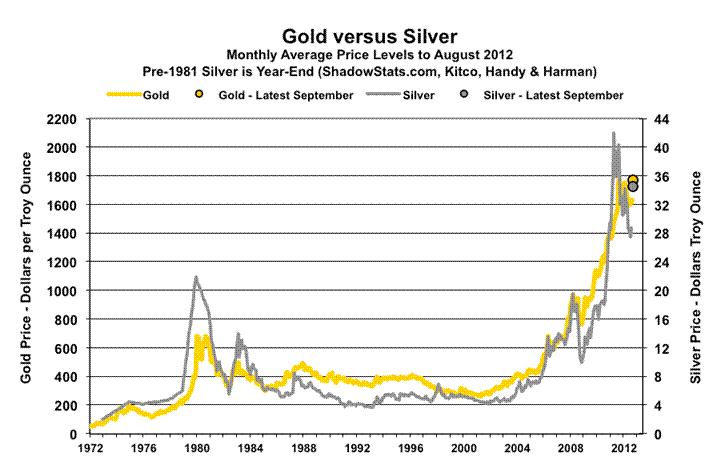
Indeed, the US dollar’s exchange value is itself a bubble waiting to pop. The sharp rise in the dollar price of gold and silver since 2003 indicates a flight from the US dollar. (The chart is courtesy of John Williams, shadowstats.com.)

The bond market bubble will pop if the dollar bubble pops. The Federal Reserve can sustain the bond market bubble by purchasing bonds, and there are no limits on the Federal Reserve’s ability to purchase bonds. However, the endless monetization of debt, even if the new money is stuck in the banks and does not find its way into the economy, can spook foreign holders of dollar-denominated assets.

Foreign central banks can decide that they want to hold fewer dollars and more precious metals as their reserves. Other countries, sensing the US dollar’s demise,


are organizing to conduct their trade without the use of the world’s reserve currency. Brazil, Russia, India, China, and South Africa intend to conduct their trade with one another in their own currencies. China and Japan have also negotiated to settle their trade balances with one another in their own currencies.

These agreements substantially reduce the use of the US dollar in international trade and, thus, the demand for dollars. When demand falls, so does price, unless the supply shrinks. But the Federal Reserve has announced, essentially, unlimited supply of US dollars. So we are faced with a paradox. The US dollar is supposed to remain valuable despite its enormous increase in supply.

In addition, China, America’s largest creditor and in the past a reliable purchaser of US Treasury bonds, holds some two trillion in dollar-denominated assets, primarily Treasury bonds. How is Washington treating its largest foreign creditor? Not with appreciation or deference. Washington is surrounding China with naval and air bases, interfering in China’s disputes with other countries, and bringing contrived actions against China in the World Trade Organization. Washington claims that US corporations are deserting the US not because of the lower cost of labor in China, but because of Chinese “subsidies” to the relocated US firms.

In my April 30 column, “Brewing a Conflict with China,” I wrote that Washington would like to substitute a cold war with China for the hot wars in the Middle East. The problem with the hot wars is the loss of superpower face from Washington’s inability to prevail after eleven years, and although the hot wars are profitable for the military/security complex, the wars don’t generate the level of profits that would flow from a high-tech arms race with China. Moreover, Washington believes that diverting Chinese investment from the economy into a military buildup would slow the rate at which the Chinese economy is overtaking the US economy.

What if instead of taking the bait from Washington, China targets Washington’s Archilles heel–the dollar’s role as reserve currency–and decides it is cheaper to dump one trillion dollars of US Treasury debt on the bond market than to commit to a 30 year arms race? To keep the price of Treasuries from collapsing, the Federal Reserve could print the money to buy the bonds. But if China then dumps the printed one trillion dollars in the foreign exchange markets, Washington cannot print euros, British pounds, Russian rubles, Swiss francs, and other currencies in order to buy up the dollars.

Frantic, Washington would try to arrange currency swaps with foreign countries in order to acquire the foreign exchange with which to buy up the dollars that, otherwise, will drive down the dollar exchange rate and destroy the Federal Reserve’s control over interest rates.

But if the Chinese don’t want the dollars, will other countries want to swap their currencies for the abandoned US dollar?

Some of Washington’s puppet states will comply, but the wider world will rejoice in the termination of Washington’s financial hegemony and refuse the offer.

Sooner or later the dollar will collapse from Washington’s abuse of the dollar’s role as reserve currency, and the dollar will lose its “safe haven” status. US inflation will rise, and US political stability, along with America’s hegemonic power, will wane.

The rest of the world will sigh with relief. And China will have defeated the superpower without an arms race or firing a shot.

Copyright © 2012 Global Research

Thursday, 10 November 2011

ECB Preparing Italy Bailout, Massive Inflation Coming

By the NIA

Italy's 10 year bond yields rose above 7% on Wednesday and economists from around the world are now proclaiming that these interest rates are unsustainable with Italy's national debt now 120% of its GDP. NIA believes the ECB is currently working on their largest bailout in history where they will commit to purchasing over €1 trillion of Italian bonds and bonds of other eurozone countries that are at risk of becoming insolvent. Despite the signals currently being given by the ECB, they will not allow Italy to fail because it will cause a Great Depression throughout the European Union, which will lead to the destruction of the eurozone.

Economists today fail to realize that 10 year bond yields of 7% are normal for not just Italy, but the rest of the eurozone and the United States. If it wasn't for the ECB holding their benchmark interest rate at artificially low levels for over a decade, Italy and other eurozone countries wouldn't have the high levels of debt they do today and they would be able to withstand yields of 7% or higher. The ECB is entirely at fault for the European Debt Crisis and they are about to follow in the footsteps of the Federal Reserve by abandoning their objective of maintaining price stability and keeping inflation low.

German 10 year bond yields declined again today to 1.72% and the spread between Germany and Italy is at a new record of 553 basis points. Germany is benefiting from safe haven buying from investors selling Italian bonds and buying German bonds, but investors will soon realize that German bonds are no better than Italian bonds and the world will dump all Euro denominated bonds.

Bond investors currently expect very little inflation in the eurozone, as seen by Germany's low bond yields. The sole reason for the large spread between German and Italian bonds is Italy's greater risk of default. However, a default by Italy would lead to the failure of Germany's largest banks. Germany knows this but they don't want to raise inflation expectations by making the world think that the ECB will be monetizing Italy's debt. Therefore, Germany is now telling Italy to request aid from the European Financial Stability Facility (EFSF) if needed.

Unfortunately, the EFSF doesn't have the financial resources to rescue a country the size of Italy. Last week, the EFSF had to cancel a €3 billion auction of 10 year bonds due to a lack of investor interest. On Monday, the EFSF finally had the bond sale, but was met with subdued interest that barely covered the €3 billion in bonds being offered. So far the EFSF has only raised a total of €13 billion through bond sales, but has received €440 billion in guarantees from eurozone countries. If Italy becomes a recipient of EFSF funding, the EFSF will lose one of their largest contributors.

The EFSF is looking to leverage up its €440 billion in funding to over €1 trillion. The European Debt Crisis was caused by too much leverage and debt. It is complete insanity to believe that the EFSF is going to solve the debt crisis when it too is getting deeply into debt and planning to use huge leverage to increase their funds available for bailouts.

There was recently a report that a proposal was made at the G20 summit last week in Cannes for Germany and other leading countries in the eurozone to pool together their foreign currency reserves including their gold reserves to back the EFSF, which would allow it to easily leverage up their funds and raise more money through bond sales. As soon as this report surfaced, Germany immediately announced to the world that they will not be using their gold reserves to boost the EFSF and that their gold reserves are "untouchable".

Germany's unwillingness to use their gold reserves clearly shows that gold is the real safe haven where individuals should store their savings if they want to keep their purchasing power. Investors buying German 10 year bonds with a yield of only 1.72% should ask themselves why Germany is willing to fund the EFSF with Euros but not their gold. Maybe investors will come to their senses and change their mind about buying any Euro denominated bonds.

For the past decade there has been a bond bubble in both Europe and the U.S. where we have seen bond yields at artificially low levels for an unprecedented amount of time. This has caused modern economists to believe that low bond yields are the new normal. When central banks interfere in the free market by manipulating interest rates to artificially low levels, it creates asset bubbles that eventually burst. When asset bubbles burst, the free market takes over and attempts to correct the damage by raising interest rates to extremely high levels, which encourages consumers to reduce their consumption and increase their savings.

NIA believes that over the next five years, 10 year bond yields will reach double digit territory throughout the eurozone and the U.S. The free market wants countries like Greece and Italy to default on their debts and restructure them, which is why their bond yields are rising so high. Although Greece and Italy have the highest debt levels in the eurozone as a percentage of GDP, the whole entire eurozone borrowed too much and has too much debt. Germany and France both know that the failure of Italy will spread to them when German and French banks with Italian debt begin to fail. The EFSF will soon be exposed as a failure itself when it is unable to attract the funding necessary to rescue eurozone countries in need of bailouts. Unless the ECB decides to bailout eurozone countries through the EFSF by buying their bonds, the ECB will be forced to directly monetize debts across the entire eurozone.

Even though the destruction of the eurozone seems imminent, NIA believes it will take time to play out. Most likely, in about two or three months from now the media will begin focusing its attention on the U.S. crisis. When the spotlight is off Italy, their bond yields will temporarily dip back down, but U.S. bond yields will skyrocket. The U.S. national debt is very close to breaking 100% of GDP, which will likely be a catalyst for investors to begin dumping their U.S. dollar denominated assets. The U.S. has unfunded liabilities many times the size of Italy's unfunded liabilities. Including unfunded liabilities, while Italy's total debts are approximately 300% of their GDP, the U.S. has total debts equaling about 600% of its GDP.

Austerity cuts are becoming very common in the eurozone and although citizens still protest them, it has become politically acceptable for politicians in Italy and other eurozone countries to support them. Italy's cash budget deficit as a percentage of GDP is currently only 3.9% and their national debt has been barely growing. The U.S. cash budget deficit as a percentage of GDP is currently 8.7%, more than double Italy, and the U.S. national debt has been growing at a record rate. Americans are used to stimulus over austerity. Members of Congress are too afraid to make necessary spending cuts. The U.S. has a budget deficit from entitlement programs and interest payments on the debt alone.

The supercommittee created by Congress to recommend $1.5 trillion in deficit reductions by November 23rd, so far hasn't agreed to make reductions to any entitlement programs. The Democrats and Republicans have so far only reached consensus on changing the way the government calculates inflation for Social Security cost of living adjustment (COLA) increases. They want to calculate inflation by using a new chain weighted CPI, which will understate inflation even more than the current CPI they use.

Based on how the current CPI has been miscalculating inflation for decades, Social Security recipients today should be receiving approximately triple their current payments. All Americans should be outraged that the government is planning to once again reduce the deficit through deception, when they should be eliminating wasteful government agencies like the Department of Energy, the Department of Education, and the Department of Homeland Security, while bringing our troops home from the middle east and immediately cutting overseas military spending in half so that we have the resources to better protect ourselves at home.

The extremely high levels of debt in both Europe and the U.S. need to be liquidated as soon as possible. If Italy can't sustain itself with 7% interest rates, which is only average on a historical basis, think about how large the crisis will be in the U.S. when interest rates here reach 15% as price inflation spirals out of control. Less than three months ago Italy's interest rates were below 5%. Fundamentally, Italy's economy is the same as it was three months ago, but perceptions in the marketplace change quickly. Today, U.S. treasuries are still perceived to be a safe haven, but this will change 180 degrees in no time.

Just like how the U.S. government understates inflation when calculating COLA adjustments, they also understate inflation when calculating GDP growth. The U.S. recently reported 3Q GDP growth of 1.62% on a year-over-year basis, which used a price deflator of only 2.52%. If they used the real rate of price inflation, they would have reported negative GDP growth. The Federal Reserve just lowered forecasts for U.S. GDP growth in 2012 to between 2.5% and 2.9%, down from a forecast in June of between 3.3% and 3.7%. In order to ensure that we even meet the Fed's new projections, the Fed will soon be launching QE3. NIA predicts that the Fed will use fears of contagion from the European Debt Crisis as their excuse for launching QE3 in the near-future. Combined with massive inflation from Europe as the ECB monetizes debt to save banks with exposure to Italian bonds, gold will soon skyrocket to new all time highs with silver likely beginning to once again outperform gold.

If you would like your friends and family members to be among the first to see NIA's 'Occupy Wall Street the Documentary' coming soon, please tell them to become a member of NIA for free immediately at: http://inflation.us